

.svg)
Quick summary
Criminal defense lawyers get found on ChatGPT and Google AI by building strong entity signals, local authority, and answer-ready content so AI systems recommend their firm for high-intent prompts like "best criminal defense lawyer near me."
- An arrested client asks AI for a lawyer before calling anyone.
- Courthouse reputation is invisible to AI until it's documented online.
- Charge-level pages let a model match your firm to a specific prompt.
- Local signals and reviews win the urgent "near me" searches.
- Most local markets have an open lane: few defense firms are optimized.
.svg)
Who this is for
This guide is written for criminal defense firms that want to be named when someone facing charges asks AI for help.
- Defense attorneys and firm owners: wanting the first call from high-value felony, federal, and white-collar matters.
- Legal marketing leads: building the entity, charge-level, and local signals AI engines cite.
.svg)
Evidence base
Built from SkyScale's AI search work for professional-services clients and reviews of defense-firm sites, combined with current 2026 public data on AI adoption and the bar-advertising rules that govern attorney marketing, reviewed through June 2026.
.svg)
Methodology
Tested criminal-defense diagnosis, charge-type, and firm-recommendation prompts across ChatGPT, Gemini, Perplexity, and Google AI Mode, and compared which entity, content, and local signals earned recommendations.
.svg)
Limitations
AI outputs are probabilistic and vary by model, location, and date. The scenarios are illustrative. Nothing here is legal advice; your state's Rules of Professional Conduct prevail.
The moment a defendant searches for help
It's late, someone has just been arrested or contacted by investigators, and a family member opens their phone. They no longer scroll a page of blue links. They ask ChatGPT for the best criminal defense lawyer nearby, or ask Google AI who handles their charge in their state. In seconds an AI system returns two or three names with reasons, and that shortlist drives the first call. Your firm is on it, or it doesn't exist for that client.
This is why AI SEO for criminal attorneys now matters as much as a strong reputation in the courthouse. The visibility battle moved upstream, into the answer itself, the shift mapped across the answer engine optimization discipline.
Why courthouse reputation doesn't reach AI yet
A respected defense lawyer can be the name every local prosecutor knows and still be invisible to ChatGPT, and that gap surprises many firms. AI models don't sit in courtrooms or read jury verdicts. They read the public, structured web. If your wins live only in case files and word of mouth, a model has nothing to work with, it can't recommend a reputation it can't see.
The firms winning AI answers aren't always the best trial lawyers; they're the ones whose expertise is documented, consistent, and easy for a machine to parse.
This is the real opportunity for skilled defense attorneys. Your courtroom record is real. The task is translating it into signals AI can read, within the limits your bar rules allow, the heart of generative engine optimization.
Why AI visibility is urgent in criminal defense
Criminal defense is one of the most competitive and time-sensitive areas of legal marketing. Cases move fast and clients decide fast, and the shift to AI search makes speed even more decisive. The trend is measurable: ChatGPT reached roughly 900 million weekly active users by early 2026, and analysts have projected a sharp drop in traditional search volume by 2026 as users move to AI assistants.
For defense firms the stakes are personal for the client and high-value for the firm, a felony or federal matter can define a person's life and a year of your caseload, so missing the AI shortlist means missing those clients entirely, the same leak detailed in why law firms are losing leads to AI search.
How an AI engine actually recommends a defense firm
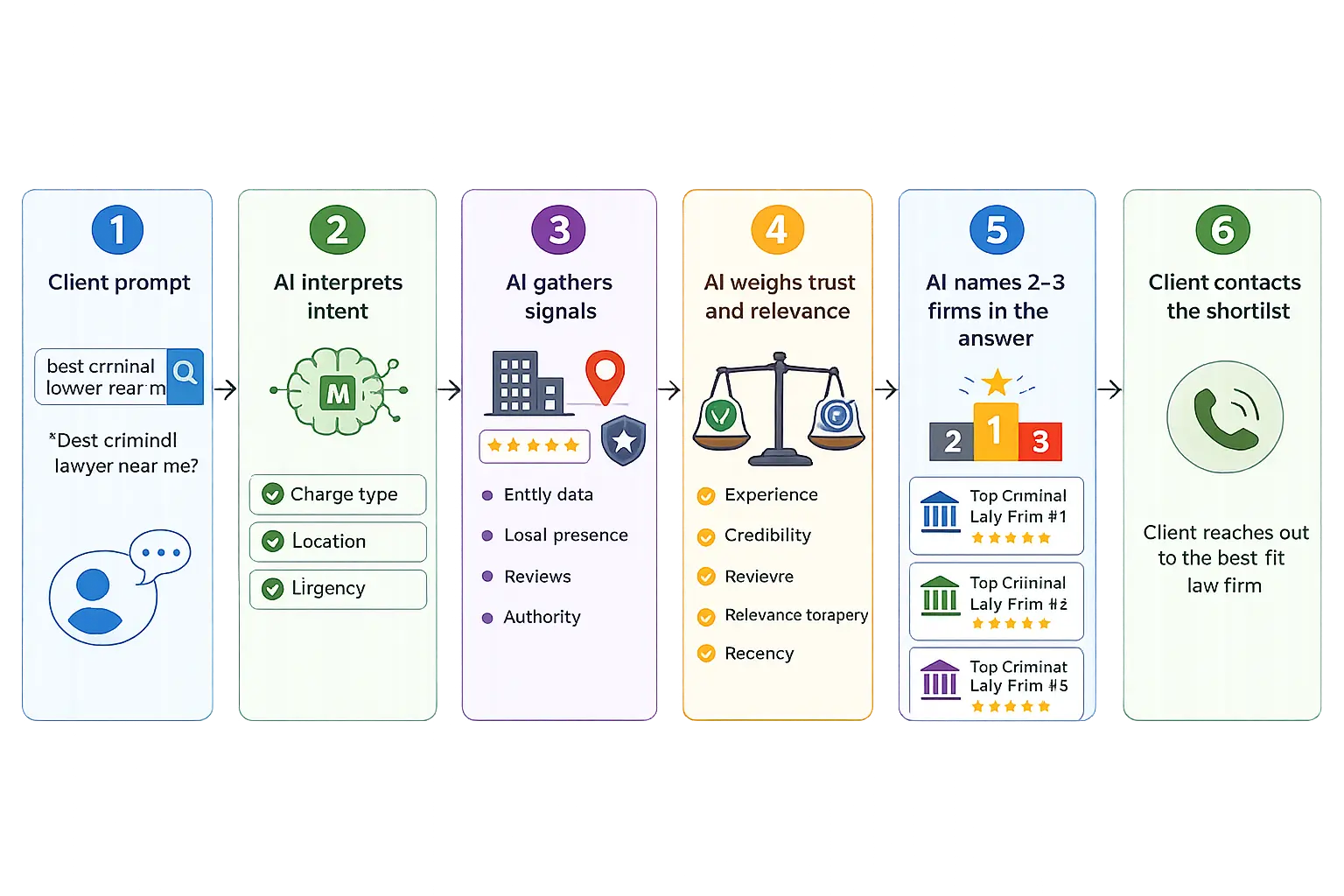
Before you optimize anything, it helps to see the path a recommendation travels. A client types a prompt ("best criminal lawyer near me"). The AI interprets intent, charge type, location, and urgency. It gathers signals: entity data, local presence, reviews, and authority. It weighs trust and relevance. It names two or three firms in the answer. The client contacts that shortlist.
Every step is a place to win or lose. If your entity data is messy, the model stumbles at gathering signals. If your authority is thin, you lose at the trust step. Optimization is the work of clearing each stage, which is why why ChatGPT recommendations matter for law firms is worth reading alongside this.
The prompts your future clients are typing
AI visibility for attorneys starts with the questions clients actually ask. Below are common criminal-defense prompts and what an AI system weighs when it answers each.
| Prompt | What AI looks for |
|---|---|
| "Best criminal defense lawyer near me" | Local signals, reviews, clear jurisdiction |
| "Top felony defense attorney" | Felony-specific content and case authority |
| "Who handles assault charges?" | Charge-specific pages and plain answers |
| "Best federal criminal attorney" | Federal court experience and authority signals |
| "Lawyer for criminal investigations" | Pre-charge and investigation content |
| "Best criminal lawyer in Texas" | State entity signals and local authority |
| "Who handles white collar crime?" | White-collar pages and credible expertise |
| "Top defense attorney nearby" | Proximity, ratings, consistent firm data |
The DEFEND framework for AI visibility
Most advice on legal AI search optimization is scattered. Organize it into one model built for defense firms, the DEFEND framework, and work the six pillars in order to cover every signal an AI engine weighs.
| Letter | Pillar | What to do |
|---|---|---|
| D | Data consistency | Make name, address, phone identical everywhere |
| E | Entity authority | Make firm and attorneys legible to the knowledge graph |
| F | Findability by charge | Build a page per charge type, plus local pages |
| E | Evidence and EEAT | Show reviews, credentials, and results carefully |
| N | Named authorship | Byline real attorneys and keep claims Rule 7.1 safe |
| D | Discoverability tracking | Measure which prompts name your firm |
The first three pillars make your firm readable to a model. The last three make it trusted and measurable. Skipping any one leaves a gap a competitor can take.
Build a page for every charge you defend
A model answering "who handles assault charges" wants a page about assault defense, not a general overview, and charge-level content is how AI matches your firm to a specific prompt. Each page should explain the charge, the stakes, and how your firm defends it, in plain language.
Map your pages to the cases you want: a felony defense page captures serious state charges, a federal criminal page signals you handle U.S. District Court matters where stakes and rules differ sharply, a white-collar page speaks to fraud, embezzlement, and investigations, and a criminal-investigations page reaches clients in the pre-charge stage when early counsel matters most.
Don't forget the common charges that drive volume, DUI, drug offenses, and domestic violence, each deserving its own clear answer.
Open every page with a direct response to the question a worried client would ask, then add the depth that proves expertise: the relevant statutes, the process, and what a defense involves, with primary references such as the Cornell criminal law library where they help.
Local signals win the "near me" prompts
Most criminal searches are local, so local lawyer SEO isn't optional. When a client asks for the best criminal lawyer in Texas or a top defense attorney nearby, AI leans on location signals to choose.
Claim and complete your Google Business Profile with accurate categories and hours, keep your name, address, and phone consistent across every directory, and publish jurisdiction pages that name the counties and courts you serve, the Gemini SEO foundation.
These steps make your firm the obvious local answer rather than a guess, and local reviews matter twice over: they influence Google's local results and feed the trust AI systems weigh when recommending a firm.
The review signal defense firms underuse
Reviews do double duty in AI visibility, feeding Google's local results and the trust AI weighs before recommending a firm, yet criminal defense firms often neglect them, partly out of discretion and partly out of habit.
You can build this signal ethically: ask satisfied clients for honest reviews without scripting the content, respond professionally, and never confirm case details that should stay private. A steady stream of recent, specific reviews, marked up with Review schema where appropriate, tells both Google and AI that real people trust your firm.
Clients also search at the worst moment, after an arrest or a late call from a detective, so make the next step obvious, a visible phone number, a short contact form, and clear after-hours guidance reduce friction when seconds feel urgent.
Stronger EEAT for defense firms
Criminal defense is a Your-Money-or-Your-Life topic, the category AI and search engines hold to the highest accuracy standard, which makes attorney authority signals essential, and most defense sites leave them on the table.
Build real depth into every key page: name your attorneys and show bar admissions, bar numbers, and the courts where they practice, and link each bio to the official state bar profile, a verifiable third-party signal.
Add professional memberships such as the National Association of Criminal Defense Lawyers, speaking history, and legitimate media mentions, and present results carefully, with disclaimers, so they inform without misleading.
Tie content to a credentialed, named author, and add original commentary when the law changes in your state. Reference primary authority where it helps, such as the U.S. Sentencing Commission for federal matters, and stay inside the rules throughout, attorney advertising is governed by ABA Model Rule 7.1 and the ABA's Formal Opinion 512 adds duties when using generative AI.
This is the ChatGPT SEO and AI SEO discipline applied to a high-stakes practice.
What we see in defense firm audits
Across the defense-firm sites we review, the same gaps repeat, and they explain why good lawyers stay invisible. Most firms run a single broad "criminal defense" page trying to cover every charge, so a model has nothing specific to match. Name, address, and phone details often differ across directories, quietly confusing the knowledge graph.
Attorney bios tend to be thin, with no credentials, bar numbers, or named authorship. Reviews are sparse or unanswered. And almost none ship LegalService or FAQ schema.
The competitive insight matters most. In many local markets, AI engines name national directories or one dominant firm because no local competitor is optimized for AI at all. That's not a closed race, it's an open lane for the first defense firm in the market to build real AI authority, which is exactly how the how US law firms get found on ChatGPT and Google AI playbook frames the opportunity.
See what AI says about your competitors
You can't plan a strategy without knowing the current answer, so run your own competitor audit before spending a dollar on optimization. Take the eight prompts above and ask each AI engine, from a clean session, for a defense lawyer in your market. Write down which firms get named, which directories appear, and which prompts return no clear local answer.
Then look at the named firms, checking their charge pages, reviews, attorney bios, and schema, and you'll usually find the reason they win is structural, not magical. Those no-answer prompts are your fastest opportunity: where AI hesitates, a well-optimized firm can become the default recommendation quickly. Our AI visibility audit runs this as a structured pass.
Score your firm: the AI visibility scorecard
Rate your firm on each DEFEND pillar from 0 to 2. Zero means absent, one means partial, two means strong. Add the scores for a total out of 12.
| Pillar | 0 (Absent) | 1 (Partial) | 2 (Strong) |
|---|---|---|---|
| Data consistency | Listings conflict | Mostly aligned | Identical everywhere |
| Entity authority | No clear entity | Some signals | Firm reads clearly |
| Findability by charge | One generic page | A few pages | Page per charge |
| Evidence and EEAT | No proof shown | Basic bios | Full credentials, reviews |
| Named authorship | Anonymous content | Some bylines | Bylined, compliant |
| Discoverability tracking | No tracking | Ad hoc checks | Prompts tracked monthly |
A score of 9 or higher means you're competitive in AI search. Five to eight means real gaps a rival can exploit. Four or below means AI rarely has enough to recommend you, and that's the most common starting point.
Which AI engines matter for defense clients
Clients move between engines without thinking about which one they use, so cover them all. ChatGPT has the largest reach and weighs the breadth of public information about your firm. Google AI Overviews sit above search results and lean on freshness and trust. Gemini draws on Google's ecosystem and the knowledge graph.
Perplexity rewards cited, source-rich content for research-style questions. Claude favors clear, well-structured, trustworthy pages. And Microsoft Copilot, built into Windows and Bing, pulls from the Bing index, so Bing Webmaster Tools and clean markup help you appear there too. The signals overlap more than they differ, as generative AI systems share much of their training and retrieval, so strong entity data, real authority, and answer-ready content lift you across every engine at once.
How long it takes and what it costs
Be wary of anyone promising instant dominance. Competitive Google rankings for criminal terms can take six to eighteen months to move, while AI citations often shift faster, sometimes within a few months, because platform competition is still relatively low.
Cost varies by market and scope: specialist AI visibility retainers for law firms commonly run from about $2,500 to $10,000 per month, with busy metros and multi-office firms reaching higher. Judge price by scope, not headline rate, prompts tracked, charge pages shipped, schema included, and how visibility is reported.
How SkyScale helps criminal defense firms get found
SkyScale was built for AI search, not retrofitted from old SEO tactics. We help US criminal defense firms become the name AI systems trust and recommend, and we work inside the rules that govern attorney marketing.
Our work covers the full discipline: AI SEO strategy ties it together, generative engine optimization builds your firm into a recognizable entity, and answer engine optimization shapes content into the answers engines reward. We tune visibility for ChatGPT and the other engines clients use, and we measure success by how often your firm appears for the prompts that bring real cases, the methodology behind our AI SEO services for US law firms and broader service stack.
To see where you stand today, start with a law firm AI visibility audit, and for deeper context read the pillar guide on AI SEO for lawyers and the related how family law lawyers get found and how personal injury lawyers get found guides.
Implementation checklist
Use this list to audit and improve your AI visibility after reading this guide.
- Run the eight client prompts across all engines and log who gets named in your market.
- Make name, address, and phone identical across every directory and your site.
- Build a dedicated page for each charge type you defend, with a direct opening answer.
- Complete your Google Business Profile and publish county and court jurisdiction pages.
- Add named attorney bylines, bar numbers, and links to official state bar profiles.
- Build a steady, ethical flow of reviews and respond without confirming private details.
- Ship LegalService, FAQPage, and Review schema across key pages.
- Score your firm on the DEFEND scorecard and re-run the prompts after 60 to 90 days.
Sources and references
Primary sources, official documentation, research and SkyScale audit data cited in this article.
- U.S. Sentencing Commission — United States Sentencing Commission
- National Association of Criminal Defense Lawyers — NACDL
- Criminal law — Cornell Legal Information Institute
- Review structured data type — Schema.org
- Bing Webmaster Tools — Microsoft
- Generative artificial intelligence — Wikipedia
Frequently Asked
How do criminal defense lawyers get found on ChatGPT?

They build consistent entity signals, real authority, and charge-level content so ChatGPT can understand and trust the firm. ChatGPT weighs the breadth of public information about your firm, so accurate bios, reviews, and jurisdiction pages help it recommend you for prompts like "best criminal defense lawyer near me."
What is the DEFEND framework?
DEFEND is a six-pillar model for legal AI visibility: Data consistency, Entity authority, Findability by charge, Evidence and EEAT, Named authorship, and Discoverability tracking. The first three make your firm readable to AI; the last three make it trusted and measurable.
What is criminal defense lawyer SEO for AI?
It's the practice of optimizing a defense firm so AI systems such as ChatGPT and Google AI Overviews recommend it. It combines local lawyer SEO, entity optimization, charge-specific content, and answer-engine work, all kept compliant with bar advertising rules.
How can I see whether AI recommends my competitors?
Ask each engine, from a clean session, for a defense lawyer in your market using the common client prompts. Note which firms and directories get named, then study their charge pages, reviews, and schema. Prompts that return no clear local answer are your fastest opportunity.
Why do "near me" prompts matter for defense firms?
Most criminal searches are local and urgent. When a client asks for the best criminal lawyer in Texas or a top defense attorney nearby, AI leans on location signals, so a complete Google Business Profile, consistent listings, and jurisdiction pages make you the local answer.
Which AI engines should defense firms optimize for?
Cover ChatGPT, Google AI Overviews, Gemini, Perplexity, Claude, and Microsoft Copilot. The signals overlap, so strong entity data, real authority, and answer-ready content lift you across every engine at once rather than one at a time.
Is AI marketing for defense attorneys compliant with bar rules?
It can be, when done carefully. Attorney advertising is governed by ABA Model Rule 7.1 and state equivalents, and Opinion 512 adds duties when using AI. A good provider builds visibility without letting any AI surface make false or misleading claims about your firm.
Authorship and review

Written by

Reviewed by
Lachlan McDonald
· AI Search & Data Engineering Reviewer
.svg)

.svg)


.svg)
.svg)
.svg)

.svg)
.svg)

.webp)