The end of page two
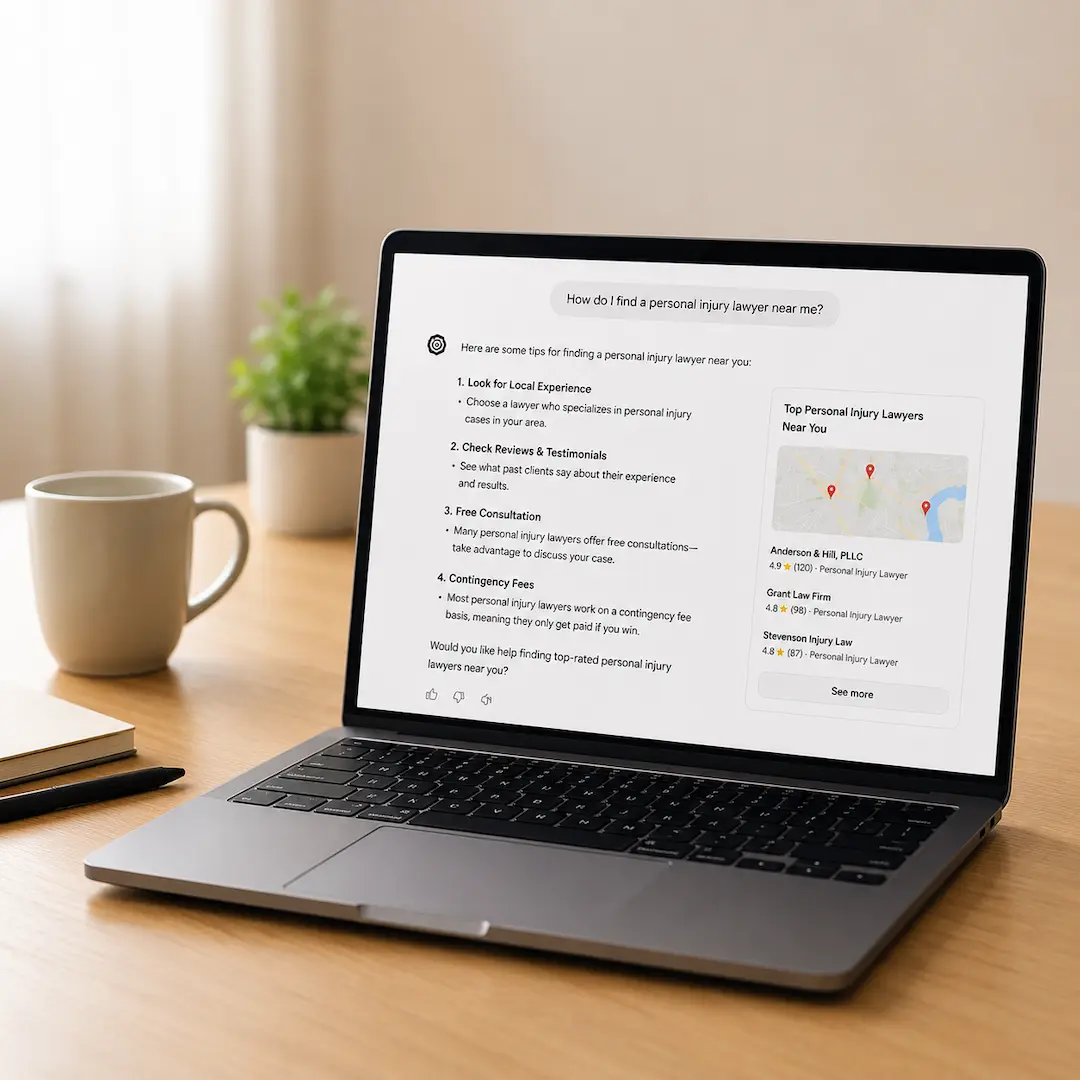
For years, personal injury marketing was a fight for page one of Google. That fight is shrinking. A growing share of legal searches now end without a click, because the answer appears right inside the results. Legal queries trigger Google AI Overviews more than almost any other high-stakes category, and when an overview shows it pulls clicks away from the links below.
Your future client reads two or three recommended firms and stops. Page two no longer exists for them, and often page one barely does either.
This is why AI SEO for personal injury lawyers is now the core of the game. The first impression happens inside the answer, before anyone visits a website, the shift that defines answer engine optimization.
Why personal injury is the hardest local race
No legal niche is more competitive or more expensive.
Personal injury firms pay far more per click than almost any advertiser, with the most contested injury keywords reportedly running into the hundreds of dollars and beyond. That economics cuts both ways: paid clicks are brutal, but AI visibility is still underpriced, and traffic from AI assistants tends to convert at high rates because the person arrives already guided toward trust.
A single recommended case can be worth a year of ad spend. The firms winning now aren't always the biggest spenders, they're the ones an AI engine can read, trust, and name, the premise of generative engine optimization.
The directory problem: why AI names Avvo, not you
Here's the insight most injury firms miss. When AI answers a legal prompt, it often leans on a small group of directories, a tight cluster of sites that dominate the AI citation layer for legal queries, including Super Lawyers, Best Lawyers, Martindale, Avvo, and Justia.
Your firm may appear inside those directories, but rarely as an independent voice, which means the AI sends the client to a list, and your competitor sitting next to you on that list has the same shot you do.
The opportunity is to become a source the AI cites directly. A firm with strong entity data and trusted content, the kind Google's own helpful-content guidance describes, can be named on its own rather than buried in a directory. That's the difference between being one of fifty names and being the recommendation, exactly what why ChatGPT recommendations matter for law firms explores.
How an AI engine recommends an injury firm
Before you optimize anything, see the path a recommendation travels. A client types a prompt ("best personal injury lawyer near me"). The AI interprets intent, injury type, location, and urgency.
It gathers signals: entity data, local presence, reviews, and authority. It weighs trust and relevance. It names a firm directly, or defaults to a directory. The client contacts that shortlist. Every step decides whether you appear as a firm or vanish into a directory, and optimization is the work of winning each stage.
The prompts your future clients are typing
AI visibility starts with the questions clients actually ask. Below are common personal injury prompts and what an AI system weighs when it answers each.
| Prompt |
What AI looks for |
| "Best personal injury lawyer near me" |
Local signals, reviews, clear jurisdiction |
| "Top car accident attorney" |
Auto injury content and case authority |
| "Who handles slip and fall cases?" |
Premises liability pages and plain answers |
| "Best injury lawyer no win no fee" |
Clear fee model and trust signals |
| "Personal injury attorney with good reviews" |
Recent, specific, answered reviews |
| "Lawyer for a workplace injury" |
Workplace and workers' comp content |
| "Best accident lawyer in my city" |
City entity signals and local authority |
| "Can ChatGPT recommend a personal injury lawyer?" |
Entity clarity and trustworthy sources |
The pattern is clear. AI rewards firms with injury-specific content and strong local signals. Generic "we handle all injuries" pages rarely win these answers.
The CLAIM framework for AI visibility
Personal injury visibility has many moving parts, so organize them into one model, the CLAIM framework. Cover all five pillars and you address every signal an AI engine weighs.
| Letter |
Pillar |
What to do |
| C |
Consistent data |
Keep name, address, phone identical everywhere |
| L |
Local dominance |
Strong Google Business Profile, reviews, geo pages |
| A |
Answer-ready pages |
A clear page per injury type you handle |
| I |
Independent authority |
Earn citations so AI names you, not a directory |
| M |
Measurement |
Track which prompts name your firm |
Consistent data and local dominance win the map. Answer-ready pages and independent authority win the AI answer. Measurement keeps the whole effort honest. Skip one pillar and a rival takes the gap.
Win the local map and the AI answer together
Most injury searches carry a location, so local SEO and AI visibility are the same fight now.
When a client asks for the best accident lawyer in their city, AI leans on the same local signals that drive Google Maps. Claim and complete your Google Business Profile with accurate categories, service areas, and hours, keep your name, address, and phone identical across every listing, and publish city and county pages that name the courts and areas you serve. Earn a steady stream of recent reviews, since they feed both the local map and AI trust, the foundation of Gemini SEO.
These signals do double duty: they lift your Maps presence and give AI the location proof it needs to name you.
Build a page for every injury you handle
A model answering "who handles slip and fall cases" wants a premises liability page, not a broad overview, and injury-specific content is how AI matches your firm to a prompt.
Each page should explain the injury, the claim process, and how your firm helps, in plain language. Map pages to the cases you want: a car accident page captures the largest share of demand, with additional pages for truck accidents, slip and fall, workplace injury, medical negligence, wrongful death, and product liability.
For the most serious matters, link to deeper resources such as our catastrophic injury AI SEO and truck accident AI SEO guides. Open every page with a direct answer to the question an injured person would ask, then add depth that proves expertise: how liability works, realistic timelines, and what compensation can cover, with tort law references where they help.
Become an independent authority AI will cite
Breaking out of the directory layer is the real prize, and it comes down to authority. Personal injury is a Your-Money-or-Your-Life topic, the category AI and search engines hold to the highest accuracy standard. Name your attorneys, show bar admissions and bar numbers, and link each bio to the official state bar profile, for example the verifiable listings maintained by bodies like the State Bar of Michigan, a strong third-party signal.
Present case results carefully, with disclaimers, so they inform without misleading, and reference primary authority where it helps, such as federal injury data from the CDC's injury and violence prevention program.
Stay inside the rules throughout, attorney advertising is governed by ABA Model Rule 7.1 and the ABA's Formal Opinion 512 adds duties when using generative AI. Authority earned this way is what moves you from a directory listing to a named recommendation, the heart of AI SEO and ChatGPT SEO for injury firms.
What we see in personal injury audits
Across the injury-firm sites we review, the same gaps repeat, and they explain why heavy spenders still lose AI answers. Most firms run one broad "personal injury" page, so a model has nothing specific to match for slip and fall or workplace prompts.
Name and address details often differ across listings, quietly confusing the knowledge graph. Reviews are strong on Google but missing the structure AI can read. Attorney bios skip credentials and named authorship. And almost none ship LegalService, ProfessionalService, or FAQ schema.
The competitive insight matters most. Because AI defaults to directories, an opening exists: the first firm in a market to build real independent authority can pull the direct recommendation away from the list, and that lane is still open in most cities, the same pattern documented in why law firms are losing leads to AI search.
See what AI says about your competitors
You can't plan without knowing the current answer, so run a competitor audit before you spend on optimization. Take the eight prompts above and ask each AI engine, from a clean session, for an injury lawyer in your city, writing down which firms get named, which directories appear, and which prompts return only a list.
Then study the named firms, looking at their injury pages, reviews, bios, and schema, and the reason they win is almost always structural. The prompts that return only directories are your fastest opening: where AI has no clear firm to name, a well-built competitor can take that slot. Our AI visibility audit runs this as a structured pass.
Score your firm: the AI visibility scorecard
Rate your firm on each CLAIM pillar from 0 to 2. Zero means absent, one means partial, two means strong. Add the scores for a total out of 10.
| Pillar |
0 (Absent) |
1 (Partial) |
2 (Strong) |
| Consistent data |
Listings conflict |
Mostly aligned |
Identical everywhere |
| Local dominance |
Weak profile |
Some signals |
Strong map and reviews |
| Answer-ready pages |
One generic page |
A few pages |
Page per injury type |
| Independent authority |
Only in directories |
Some citations |
Cited directly by AI |
| Measurement |
No tracking |
Ad hoc checks |
Prompts tracked monthly |
A score of 8 or higher means you compete well in AI search. Four to seven means real gaps a rival can take. Three or below means AI rarely names you on your own, which is the most common starting point.
Which AI engines matter for injury clients
Clients move between engines without thinking about which one they use, so cover them all. ChatGPT has the largest reach and weighs the breadth of public information about your firm. Google AI Overviews sit above search results and lean on freshness and trust. Gemini draws on Google's ecosystem and the knowledge graph.
Perplexity rewards cited, source-rich content. Claude favors clear, trustworthy pages. Microsoft Copilot pulls from the Bing index, so clean markup helps. And Grok surfaces firms with an active, credible public presence. The signals overlap more than they differ, so strong entity data, local proof, and answer-ready content lift you across every engine at once.
Why AI traffic is worth more than it looks
Injury clients who arrive from an AI answer aren't cold searchers. The model has already filtered for trust, so the person lands closer to hiring, and reported conversion rates from AI assistants run well above typical organic search, which makes each recommendation unusually valuable.
That changes the math on where to invest: a firm fighting for one more paid click can instead earn a recommendation that arrives pre-qualified, and while the work isn't cheap, the return compounds because an AI citation keeps surfacing your firm long after a paid campaign ends.
Make the next step easy when that client lands, a visible phone number, a short intake form, and clear fee answers reduce friction at the moment someone is ready to act.
How long it takes and what it costs
Be wary of anyone promising instant dominance. Competitive Google rankings for injury terms can take six to eighteen months to move, while AI citations often shift faster, sometimes within a few months, because platform competition is still relatively low.
Cost varies by market and scope: specialist AI visibility retainers for law firms commonly run from about $2,500 to $10,000 per month, with major injury markets reaching higher. Judge price by scope, not headline rate, prompts tracked, injury pages shipped, schema included, and how visibility is reported.
How SkyScale helps personal injury firms get found
SkyScale was built for AI search, not retrofitted from old SEO tactics.
We help US personal injury firms become the name AI systems trust and recommend, and we work inside the rules that govern attorney marketing. Our AI SEO services for US law firms tie it together, generative engine optimization builds your firm into a recognizable entity, and answer engine optimization shapes content into the answers engines reward.
We tune visibility for ChatGPT and the other engines clients use, and we measure success by how often your firm appears for the prompts that bring real cases, with the full service stack behind it.
To see where you stand today, start with a law firm AI visibility audit, and for deeper context read the pillar guide on AI SEO for lawyers, plus the related how criminal defense lawyers get found and how family law lawyers get found guides.
Where this leaves your firm
When someone is hurt, they reach for AI before they reach for a phone book. The injury firms that appear in those answers win the first call, and often the case, before a competitor knows the search happened.
Strong personal injury lawyer SEO for AI isn't a trick: run the CLAIM framework, score your firm honestly, audit your competitors, and break out of the directory layer. The firms that act in 2026 are the ones AI will recommend in 2027.


.svg)
.svg)
.svg)
.svg)
.svg)



.svg)

.svg)


.svg)
.svg)
.svg)

.svg)
.svg)

.webp)