.svg)
Quick summary
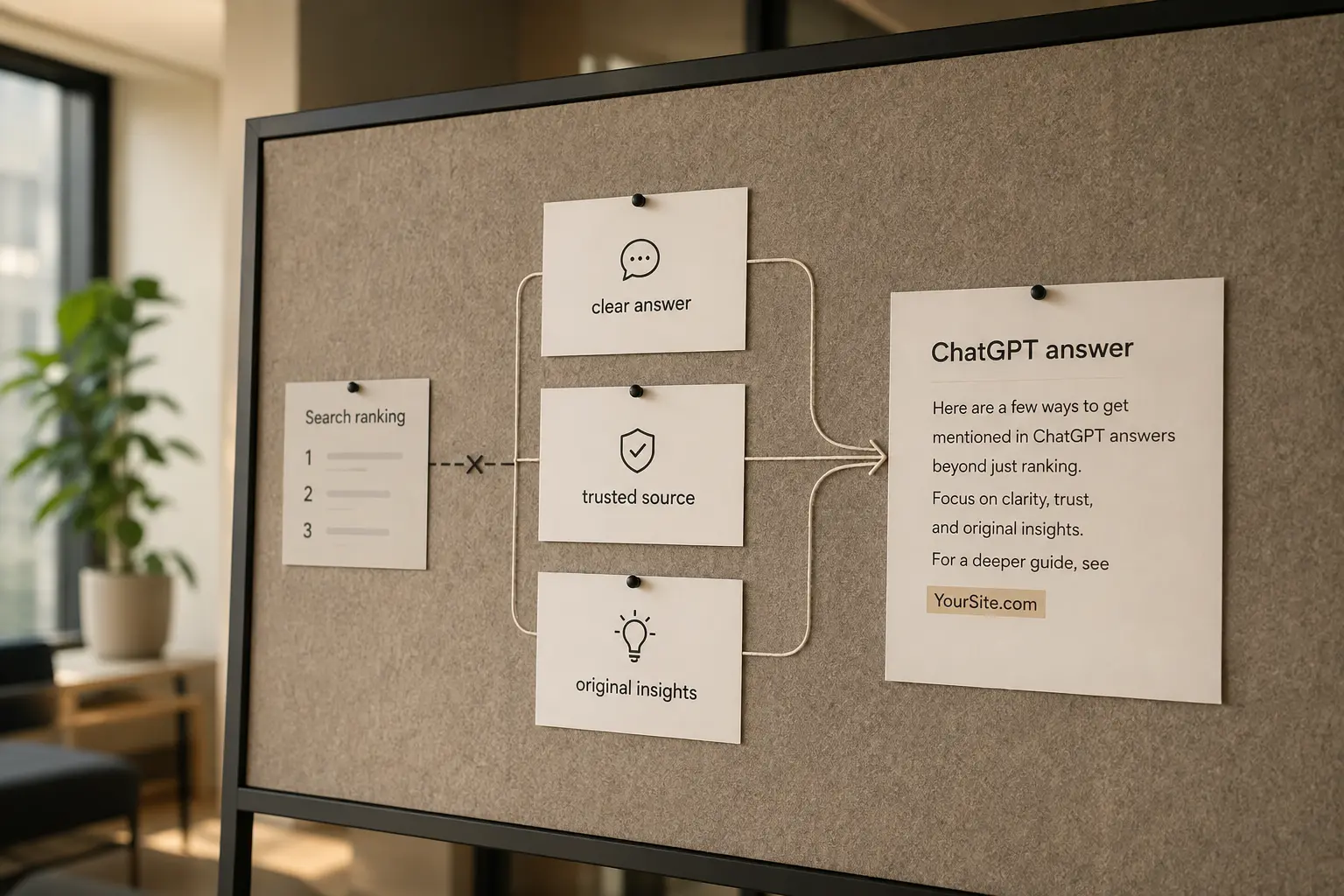
ChatGPT does not rank pages the way Google does. It learns from training data, browses the web in real time, and selects sources based on relevance, expertise, structure and recency. To be chosen, your content needs to be clear, credible, well-structured and current.
- ChatGPT selects and synthesises sources, it does not rank a list.
- Credibility, expertise and transparent methodology drive selection.
- Recency matters; current content wins for time-sensitive queries.
- Structured, machine-readable content is far easier for AI to cite.
- Mentions and authority signals count more than keyword tactics.
.svg)
Who this is for
This guide is written for teams who want to understand and influence whether ChatGPT cites their brand.
- Marketing and SEO leads: wanting to become a source ChatGPT trusts, not just a ranked page.
- Founders and content owners: structuring content so AI selects and references it accurately.
.svg)
Evidence base
Drawn from SkyScale's AEO and GEO work across 200+ audits and client programs completed between October 2024 and May 2026 across B2B SaaS, professional services and ecommerce.
.svg)
Methodology
Ran category, comparison and question-style prompts in ChatGPT with browsing, then compared which pages were cited against their structure, authority and freshness.
.svg)
Limitations
AI responses are probabilistic and ChatGPT's internal process is not fully public. Results vary by model, version, location and prompt wording. Reported click and citation figures vary widely between studies and should be treated as directional.

Implementation checklist
Use this list to audit and improve your AI visibility after reading this guide.
- Allow reputable AI crawlers so your content is eligible for citation.
- Create expert-backed content with transparent methodology and sources.
- Signal purpose clearly in titles and headings (guide, tutorial, examples).
- Add FAQ, Article and Organisation schema, and consider an llms.txt file.
- Build authority through mentions on trusted industry publications.
- Keep entity signals consistent and content freshly updated.
- Publish original research, data and case studies for primary-source citations.
- Track AI mentions, citations and sentiment, then refresh what underperforms.
Sources and references
Primary sources, official documentation, research and SkyScale audit data cited in this article.
- OpenAI bots and GPTBot — OpenAI
- Illustrating Reinforcement Learning from Human Feedback (RLHF) — Hugging Face
- llms.txt — llms.txt proposal
- Bing Webmaster Tools — Microsoft Bing
- FAQPage structured data type — Schema.org
- Search Essentials — Google Search Central
Frequently Asked
How does ChatGPT choose which sources to cite?

ChatGPT combines patterns from its training data with real-time web browsing, then selects sources based on relevance, expertise, transparency, structure and recency. It favours credible, well-organised content and, for sensitive topics, official institutional sources.
Does ChatGPT rank websites like Google?
No. It does not produce a ranked list. It retrieves, synthesises and cites the content it considers most credible and relevant to the question, so visibility depends on authority, clarity and structure rather than ranking position alone.
How can I increase my chances of being cited by ChatGPT?
Publish comprehensive, expert-backed content with clear methodology, add schema markup, build authority through trusted mentions, keep entity signals consistent, refresh content regularly, and share original research that is not available elsewhere.
Why does recency matter for ChatGPT source selection?
ChatGPT often applies recency filters for trending or time-sensitive queries, sometimes only considering very recent sources. Regularly updating key pages helps your content stay eligible when freshness is part of what the model is weighing.
What is an llms.txt file and should I use one?
An llms.txt file is an emerging standard placed in your site root that communicates your structure and key content to AI systems in a clean, machine-readable way. It is early but low-cost to implement and aligned with how AI discovery is developing.
Is technical SEO still important for being cited by AI?
Yes. Fast loading, mobile-friendliness, crawlability, internal linking and clean structure let AI systems access and interpret your content. Without that foundation, even well-written content is harder for ChatGPT to parse and cite.
Authorship and review

Written by

Reviewed by
Lachlan McDonald
· AI Search & Data Engineering Reviewer
.svg)

.svg)


.svg)
.svg)
PREVIOUS POST
.svg)
.svg)
.svg)