.svg)
Quick summary
Measuring AEO ROI means linking AI visibility to revenue, not clicks. Track brand mentions, citations and sentiment across the major answer engines, then connect them to assisted conversions and pipeline in GA4 and your CRM.
- Track AI visibility, citations and sentiment across every major answer engine.
- Use GA4 and CRM data to capture assisted conversions, not just last-click traffic.
- Expect early signals in 30 to 90 days; revenue impact lands later.
- Report pipeline influence and lead quality, not vanity traffic numbers.
- Benchmark competitor share of AI answers every month.
.svg)
Who this is for
This guide is written for teams who need to prove that AI search visibility is driving real business outcomes.
- B2B SaaS marketing leads: wanting to justify AEO spend with pipeline, lead quality and revenue influence.
- SEO and content managers: moving from rankings and clicks to AI visibility, attribution and assisted conversions.
.svg)
Evidence base
Drawn from SkyScale's AEO measurement work across 200+ audits and live client dashboards completed between October 2024 and May 2026 across B2B SaaS, professional services and ecommerce.
.svg)
Methodology
Tracked AI visibility, citations and sentiment across ChatGPT, Gemini, Perplexity and Google AI Overviews, then connected results to GA4 and CRM attribution to map assisted conversions and pipeline.
.svg)
Limitations
AI responses are probabilistic. Results vary by model, location, prompt wording and freshness. These are observed patterns and correlation-based attribution, not guaranteed ranking or revenue factors.

The measurement blind spot most Australian brands haven't noticed
Open your analytics and things might look healthy. Rankings holding, sessions steady, conversions ticking over. The trouble is that a growing share of buying decisions now starts somewhere your dashboard can't see, inside a conversation with ChatGPT, Perplexity, Gemini, or a Google AI Overview.
Picture the journey. Someone asks an AI assistant for the best tool in your category for a mid-sized team. Your brand gets named in the answer. The buyer never clicks.
Three weeks later they type your name straight into Google and request a demo. Standard analytics records that as branded or direct traffic and quietly takes the credit, missing the AI-mediated discovery that actually kicked the whole thing off.
That gap is the entire reason measuring answer engine optimisation feels harder than SEO ever did. Traditional metrics were built for a click-based web. AI search routinely delivers the answer without the click. So before we get to KPIs, accept the underlying shift: you are measuring influence and authority now, not just position and traffic.
What "AEO ROI" actually means
Here is where a lot of reporting falls over. Teams try to force AEO into a last-click model, then panic when the numbers look thin and conclude it isn't working.
AEO runs on what we would call visibility without traffic. The primary value isn't an immediate click. It is being present, and trusted, at the moment an AI engine recommends a solution. Since OpenAI rolled search into ChatGPT, that recommendation moment has only grown more common.
When your brand is cited inside an answer, three things happen at once: you stay top of mind in your category, you borrow the AI's implicit endorsement, and you shape a purchase decision that closes later through a different channel.
In practice, AEO ROI is the business outcome you can connect back to that visibility: branded demand, higher-quality leads, shorter sales conversations, and pipeline that simply wouldn't exist if an AI engine had named a competitor instead of you.
The three layers of metrics that matter
You need metrics from three layers working together. Looking at any single one in isolation gives a misleading picture, and that is usually where dashboards go wrong.
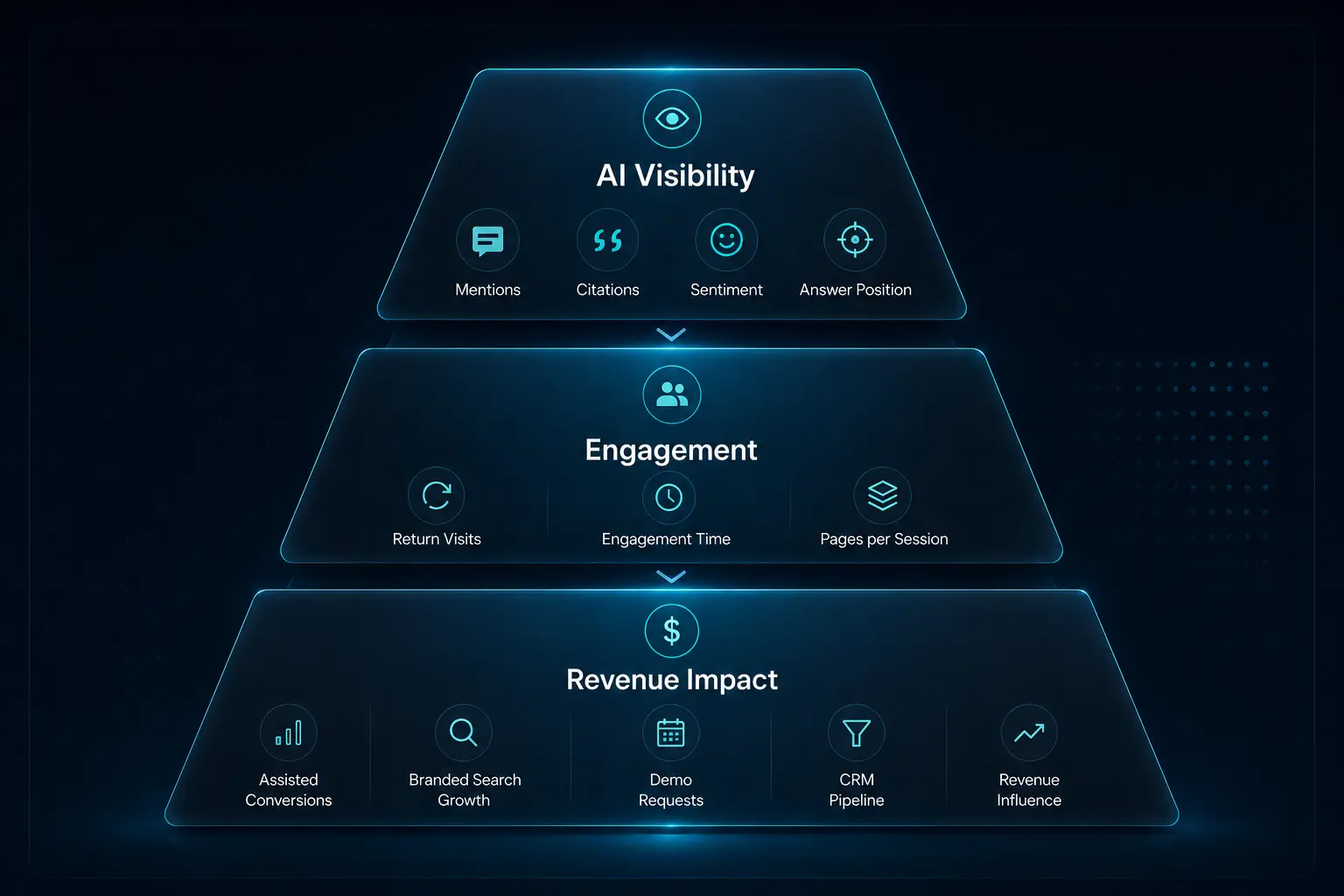
Visibility metrics
These measure how often, and how prominently, you appear across answer engines.
- AI visibility score: how frequently your brand surfaces across ChatGPT, Gemini, Perplexity and AI Overviews for your core prompts. This is your share of voice in AI search.
- Position in the answer: being named first reads very differently to being a footnote in the fourth paragraph. Placement signals perceived authority.
- Citation (attribution) frequency: being mentioned is good, but being credited as the source is transformational. A clear "according to your brand" carries far more weight than an uncredited statistic.
- Sentiment: AI engines learn tone from reviews, articles and discussions. A brand can be mentioned constantly yet positioned weakly, so track how you are described, not just whether you appear.
If citations are your weak point, that nearly always traces back to content structure and authority signals. Google's own advice on creating helpful, people-first content is the baseline here, and our breakdowns on content cited by LLMs and how ChatGPT selects sources explain the rest.
Engagement metrics
These tell you whether that visibility is bringing the right people.
- Average engagement time and pages per session: AI-referred visitors have usually done their homework before they land, so they tend to go deeper than cold organic traffic.
- Bounce rate: a lower rate suggests the AI engine pre-qualified the visitor well.
- Return visitors: an under-rated signal that AI discovery is seeding branded demand you will cash in later.
Revenue and attribution metrics
These are where AEO earns its budget.
- Assisted conversions: actions influenced by an earlier AI touchpoint, even when the final click came from somewhere else.
- Branded search growth: one of the most reliable proxies you have for rising AI visibility.
- Demo requests, sales-qualified leads, pipeline influence: for B2B, pipeline quality almost always matters more than raw traffic volume.
For B2B SaaS especially, this is the line between we got traffic and we got revenue. Our AEO for B2B guide covers how those longer journeys behave.
How to measure AEO ROI, step by step
1. Define what success looks like first
Before touching a tool, decide what you are proving: branded search growth, demo requests, AI Overview appearances, or lead quality. The most common failure we see is teams tracking impressions and never tying them to a business result. Impressions feel like progress, but they aren't proof.
2. Track visibility across the engines that matter
Build a library of 20 to 30 prompts that mirror how real customers research, not keywords but full questions like which tool integrates with our platform for a 50-person team. Run them weekly across ChatGPT, Perplexity and Gemini, logging mentions, citations, position and sentiment.
Each engine behaves differently. Perplexity leans on linked, authoritative sources, Gemini rewards clean structure, and ChatGPT often pulls from thought-leadership content, so segment your reporting by platform rather than averaging it into one meaningless number.
3. Connect GA4 and your CRM
GA4 is your bridge for assisted conversions, direct-traffic patterns, branded-search behaviour and returning users. Layer in custom events for form submissions, demo requests and key page views, and lean on its data-driven attribution to spread credit across touchpoints.
Then connect your CRM, whether HubSpot, Salesforce or Pipedrive, so AI visibility links through to lead quality, opportunity progression and pipeline. This matters most across longer B2B cycles, where the conversion can sit weeks behind the first AI mention.
4. Measure assisted conversions, not just last click
AI search rarely converts on the spot. It moves awareness, trust and intent earlier in the journey. Watch repeat visits, branded demand and SQLs rather than expecting a clean single-session conversion.
A worked example makes the point. Say branded search lifts 40 percent over a quarter while your AI visibility score climbs in parallel, and direct-traffic demo requests rise alongside it. No tool will hand you a tidy AI-to-demo line, but the correlation, tracked consistently, is a defensible ROI story.
5. Build a simple, repeatable monthly report
Keep it deliberately boring: AI visibility trends, branded search growth, assisted conversions and revenue influence. A good dashboard answers one question at a glance, which is whether AI visibility is improving business outcomes. If a metric doesn't help answer that, it is clutter.
Leading vs lagging indicators
Splitting your metrics this way stops impatient stakeholders writing AEO off too early. Leading indicators, such as AI mentions, branded searches and engagement growth, move first and tell you the strategy is taking hold.
Lagging indicators, such as conversions, pipeline and revenue, confirm it commercially, but they trail by weeks or months. Report both, and explain which is which, so nobody mistakes a slow-revenue month for a failing channel.
Why AEO attribution is genuinely different
Traditional SEO leans on a fairly direct search-to-conversion path. AEO produces zero-click discovery journeys: a buyer meets you in ChatGPT, compares options in Perplexity, then converts via a direct visit a fortnight later.
The principle has its own academic grounding in generative engine research, and the practical takeaway is blunt. No single tool stitches that journey together perfectly, and anyone promising exact, deterministic attribution is overselling it.
The honest approach is multi-touch and trend-based. Distribute credit across discovery, engagement, comparison and conversion, then validate with correlation. Does branded search and direct traffic rise when your AI visibility rises?
When it does, repeatedly, you have a story you can stand behind without a perfect last-click trail. It is the same logic underpinning generative engine optimisation measurement more broadly, and it is worth being clear on how AEO and GEO differ before you report on either.
The tools worth using in 2026
No single platform tracks everything, so most teams run a small stack.
Analytics and CRM, the foundation. GA4 for assisted conversions and attribution patterns, plus HubSpot, Salesforce or Pipedrive for lead quality and pipeline. Start here. Without this layer, visibility data floats free of revenue and your reporting never reaches the boardroom.
AI visibility trackers. A fast-growing field of purpose-built tools monitors brand mentions, citations and sentiment across multiple engines, with daily prompt testing and competitor benchmarking.
Enterprise platforms such as Profound, Gauge and XFunnel focus on multi-engine analytics, security and team workflows. Mid-market options such as SE Ranking and Surfer bolt AI tracking onto familiar SEO data. Lighter, lower-cost tools like Otterly.ai and Productrank.ai suit startups finding their feet. Treat any tool's headline score as directional, not gospel.
Manual prompt checks. Don't skip these. Automated tools miss nuance, and running your prompt library by hand each week catches phrasing and sentiment shifts the dashboards gloss over.
AI bot monitoring. Check your server logs or CDN for crawler activity from GPTBot, Google-Extended and similar agents. It tells you which pages the engines are actually retrieving and reusing, a quiet but useful signal of what is earning attention.
Whatever you choose, match the tool to your size and goals, not the longest feature list. A startup tracking ChatGPT citations needs something very different from an enterprise managing visibility across AI-driven search at scale.
Tracking Google AI Overviews specifically
Plenty of brands optimise for ChatGPT and ignore AI Overviews entirely, a real gap given Google still drives most search behaviour across Australian industries. Google's own guidance on AI features in Search makes clear this isn't rank tracking.
A page can sit outside the top three organic results and still be cited inside the AI summary, so you are monitoring citation appearances, answer inclusion, and which entities Google associates with your brand.
Pages that earn those spots tend to answer questions directly, use clean structured data for AEO with the right Article structured data markup, and cover topics thoroughly. If this is a priority, our Google AI Overview optimisation walkthrough is the place to begin.
Reporting to stakeholders without drowning them
Different audiences want different things, and one bloated dashboard serves neither well. Marketing teams care about visibility, engagement and traffic quality. Executives care about pipeline influence, lead quality, branded demand and revenue trends. Split the views accordingly.
The fastest way to lose executive buy-in is a report crammed with disconnected SEO metrics that never reaches the word revenue.
Common mistakes that quietly kill AEO reporting
A handful of patterns show up again and again. Tracking traffic only, and ignoring the assisted conversions AEO actually moves. Counting mentions without sentiment, when volume means little if you are positioned poorly inside the answer.
Chasing quantity over citation quality, when a few authoritative citations usually outperform dozens of weak ones. And skipping competitor benchmarking, which leaves you blind to who is winning the answer and where the content gaps sit. Strong entity-based optimisation often explains why a competitor gets cited and you don't.
Getting started: a realistic timeline
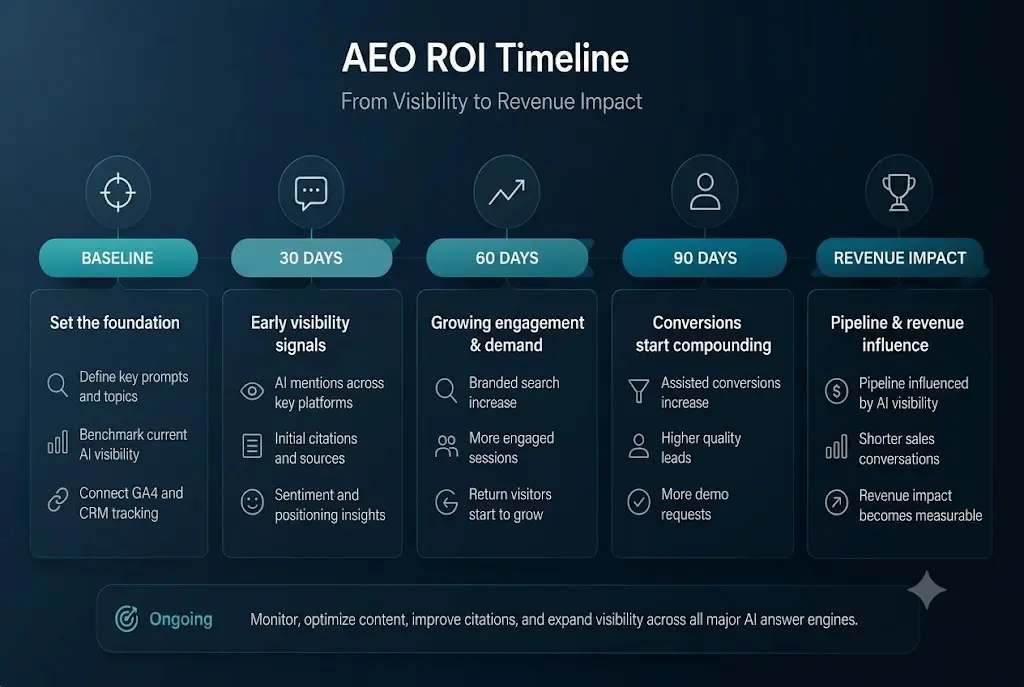
Set your baselines before you optimise, because you can't prove growth you never measured. Begin with weekly prompt testing across your top three topics and basic bot monitoring in your logs.
Most businesses see early signals, such as branded search growth, more mentions and stronger engagement, within 30 to 90 days. Revenue impact takes longer, because the journeys are multi-touch by nature.
The brands that win the AI-search era won't be the ones with the prettiest traffic charts. They will be the ones who measured influence early, connected it to pipeline, and kept adjusting while their competitors were still admiring their organic sessions.
If you would rather not build all this from scratch, a free AI visibility audit is the quickest way to see where you currently stand across the major engines.
Implementation checklist
Use this list to audit and improve your AI visibility after reading this guide.
- Define one primary business outcome (pipeline, demos, lead quality) before tracking anything.
- Build a 20 to 30 prompt library that mirrors real customer research questions.
- Track visibility, position, citations and sentiment separately for each AI engine.
- Connect GA4 events to your CRM so visibility links to pipeline, not just traffic.
- Set baseline metrics now, before optimisation, so growth is provable later.
- Report leading and lagging indicators separately to manage stakeholder expectations.
- Benchmark competitor share of AI answers monthly to spot gaps early.
- Run manual prompt checks weekly to catch sentiment and phrasing shifts tools miss.
Sources and references
Primary sources, official documentation, research and SkyScale audit data cited in this article.
- Introducing ChatGPT search — OpenAI · October 31, 2024
- Generative Engine Optimization: Optimizing Website Visibility in Generative Engines — Princeton University / arXiv · November 16, 2023
- AI features and your website — Google Search Central
- Attribution and conversion paths in GA4 — Google Analytics Help
- Article structured data — Google Search Central
- Creating helpful, reliable, people-first content — Google Search Central
Frequently Asked
How long does it take to see ROI from AEO?

Most businesses see early signals, such as branded search growth, more AI mentions and stronger engagement, within 30 to 90 days. Revenue impact usually takes longer, because AI-driven journeys involve several touchpoints before a conversion lands.
Which tools are best for tracking AEO ROI?
A practical stack pairs GA4 and a CRM (HubSpot, Salesforce or Pipedrive) with an AI visibility tracker. Enterprise teams lean toward Profound, Gauge or XFunnel, while smaller teams favour SE Ranking, Surfer, Otterly.ai or Productrank.ai.
Can AEO be measured if users never click a link?
Yes, indirectly. Zero-click discovery shows up as branded search growth, direct-traffic spikes, repeat visits and delayed conversions. Correlating AI visibility with that downstream behaviour reveals real influence beyond last-click attribution.
What is the difference between AI visibility and citation frequency?
Visibility measures presence, meaning how often you appear. Citation frequency measures authority, meaning how often you are named or linked as the source. Being cited carries far more trust and recall than simply being included.
Why don't traditional SEO metrics show AEO performance?
Rankings, clicks and sessions were built for a click-based web. AI search often answers the query in place, so AI-led discovery surfaces later as branded or direct traffic, creating a blind spot in standard analytics.
How often should AEO KPIs be reviewed?
Monitor core prompts and AI visibility weekly, and report trends monthly. AI models, competitors and content ecosystems shift quickly, so regular review lets you catch declines or new gaps before they cost market share.
Authorship and review

Written by

Reviewed by
Lachlan McDonald
· AI Search & Data Engineering Reviewer
.svg)

.svg)


.svg)
.svg)
.svg)

.svg)
.svg)