Why E-E-A-T is the gatekeeper for AEO
As search engines evolve into answer engines, how brands get discovered is fundamentally changing. Users now expect direct, authoritative answers, often without clicking through, and AI-powered platforms select the single most credible and relevant response.
If your content is not clearly positioned as the definitive answer, it risks being overlooked entirely.
This is where Google's E-E-A-T framework moves from optional to essential for answer engine optimisation. E-E-A-T acts as the gatekeeper for what ranks highly, especially in featured snippets and voice results where only one answer appears.
To succeed, content must be more than keyword-rich; it must demonstrate undeniable credibility, deliver crystal-clear answers, and align with how people actually search, the foundation of what AEO is.
Decoding E-E-A-T
E-E-A-T is the acronym for the four pillars Google uses to assess content quality. While traditional SEO focuses on ranking in a list, AEO is a battle for position zero, the single definitive answer, and E-E-A-T determines the winner.
Experience signals that content is created by someone with direct, first-hand knowledge. For AEO this is non-negotiable, since insights must come from real practice, not theory; a software review written by someone who has used the product for months carries more weight than one written from a press release.
Expertise refers to deep, specialised knowledge, with answer engines favouring creators who show technical, nuanced understanding, like a tax article written by a qualified accountant, the kind of credential bodies such as CPA Australia certify.
Verifiable identifiers like an ORCID record can further substantiate an author's expertise.
Authoritativeness is about reputation, with Google looking for recognised leaders supported by credentials, citations and media coverage, the same authority that authoritative databases like PubMed carry in medical topics.
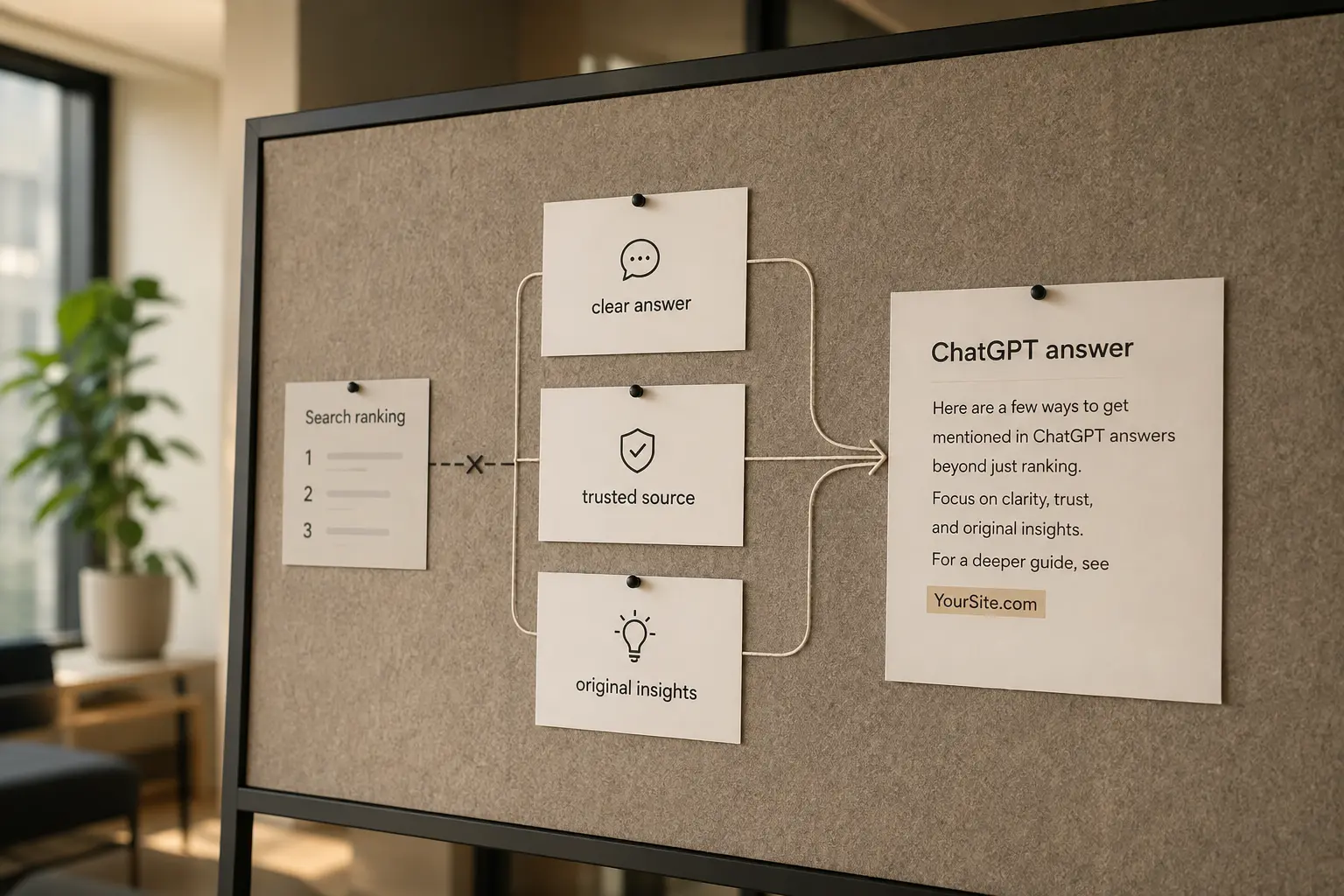
Trustworthiness signals that content is accurate, transparent and dependable, from fact-checking and citing sources to a secure website. These pillars also shape how ChatGPT selects sources.
The evolution of E-E-A-T
The framework was not always this comprehensive. Google first introduced E-A-T, for Expertise, Authoritativeness and Trustworthiness, in its Search Quality Rater Guidelines in 2014.
These guidelines are a manual used by human evaluators to assess search quality, and their feedback helps Google refine its algorithms.
In December 2022, Google officially added the first "E" for Experience, updating the framework to E-E-A-T.
This was a significant acknowledgement that first-hand, real-world involvement provides a layer of credibility that expertise alone cannot capture, and a direct response to the need for more authentic, human-centred content as AI-generated material became more prevalent, exactly the dynamic behind why AI rejects keyword stuffing.
E-E-A-T and YMYL: when the stakes are high
The principles of E-E-A-T matter for all content, but they are critical for topics Google classifies as Your Money or Your Life, meaning topics that could significantly affect a person's health, financial stability, safety or wellbeing.
Examples include medical advice and health information, financial planning and investment guidance, legal advice, and news and current events.
For these topics, the bar for credibility is far higher. In health, authoritative sources like PubMed set the standard for evidence, while in finance, government resources like MoneySmart model the transparency and accuracy expected of trustworthy guidance.
If you publish in a YMYL area, your content must visibly demonstrate qualified expertise, cite reputable sources, and be reviewed and kept current, since both search engines and AI engines apply extra scrutiny before surfacing or citing it.
Implementing E-E-A-T: demonstrate credibility
Optimising for E-E-A-T is a strategic commitment to quality, not a one-off task, and it starts with visibly demonstrating credibility. Showcase clear author bios on every piece of content, including credentials, years of experience, relevant accomplishments and links to a profile or portfolio, so both readers and engines can see who stands behind the work.
Go beyond theory by documenting real processes, using screenshots, case studies and step-by-step walkthroughs to show you have actually done what you are writing about, the firsthand proof that signals Experience.
And back up your claims by citing reputable sources, linking to academic journals, government websites and respected industry publications, which strengthens Authoritativeness and is central to creating content cited by LLMs.
Implementing E-E-A-T: deliver clarity
Credibility only helps if engines can extract your answer cleanly, so structure for answers. Use question-based headings that mirror real search queries, and provide a clear, concise answer directly below each heading before expanding with detail.
Write in natural, conversational language, avoiding jargon and robotic phrasing, since content that reads like a natural answer to a spoken question performs better in voice search and AI snippets, a principle we cover in engaging content for LLMs and winning voice search.
Then make your structure machine-readable. Implement FAQ, HowTo and Article schema to give engines a structured blueprint of your content, making it easier for them to interpret and feature your answers, the foundation we detail in structured data for AEO and transforming your FAQ strategy.
Implementing E-E-A-T: align with search behaviour
Strong content meets users where they are, so map the user journey using tools like AnswerThePublic and Google's People Also Ask to understand the questions your audience asks at every stage, from awareness to decision, the same intent work behind mastering search intent.
This ensures your content answers what people genuinely want to know.
It also helps to analyse winning snippets, studying the content that already holds featured snippets for your target keywords and reverse-engineering its structure, formatting and depth, which connects directly to optimising for AI Overviews and snippets. Finally, keep content fresh, since in fast-moving industries outdated information is a trust-killer, so audit and update regularly to stay accurate and relevant.
Trustworthiness in practice
Trustworthiness is often the deciding factor, and it shows up in concrete signals. Secure your website with HTTPS, since a secure, well-maintained site, supported by infrastructure from providers like Cloudflare, is a baseline trust signal for both users and engines.
Be transparent about sourcing and methodology, clearly stating where your information comes from.
Fact-checking matters just as much, and adopting the kind of standards championed by organisations like the Poynter Institute signals that your content is accurate and accountable.
Publishing your review or fact-checking process, naming the experts who vet content, and correcting errors openly all reinforce trust.
As one practical example, leading fintech publishers have every article reviewed by a qualified financial planner and publish their internal fact-checking standards, which satisfies engines and builds lasting trust with readers.
Measuring the impact of your E-E-A-T efforts
E-E-A-T is not a direct metric, but its impact is visible through several indicators. Watch organic traffic growth, since rising traffic suggests your content is ranking higher and attracting more users.
Monitor keyword rankings and featured snippets, paying close attention to whether you capture position zero. Look at user engagement signals like time on page and pages per session, since content with strong E-E-A-T tends to hold attention longer.
And track conversion rates, because higher trust and authority often translate into more newsletter sign-ups, enquiries or purchases.
Together these tell you whether your investment in credibility is paying off, and they connect to the broader outcome focus in how to measure AEO ROI.
Pair this measurement with a regular generative AI visibility audit to find where your E-E-A-T signals need strengthening.
Your blueprint for AI search visibility
E-E-A-T is no longer just a set of guidelines; it is the foundation for visibility in an AI-driven search world. As engines prioritise single, definitive answers, the content that wins will be undeniably experienced, expert, authoritative and trustworthy.
To future-proof your presence, embed these principles into every stage of your content workflow, moving beyond simply creating content to creating the most credible and helpful answer available.
When you structure for clarity, align with conversational intent, and let genuine expertise shine, you position your brand to be the one AI chooses first across AI search, ChatGPT and your wider Australian AEO strategy.
To see where your credibility signals stand today, a free AI visibility audit or SkyScale's services is the fastest place to start.


.svg)
.svg)
.svg)
.svg)
.svg)




.svg)

.svg)


.svg)
.svg)
.svg)
.svg)
.svg)