.svg)
Quick summary
AEO for B2B means structuring your expertise so AI engines cite you as the trusted source, rather than just ranking a page. You win by answering buyer questions clearly, marking up your content, and earning third-party mentions that AI systems read as authority.
- Optimise for citations and authority, not just keyword rankings.
- Structure content as clear, direct answers to real buyer questions.
- Use schema, clean headings and self-contained passages AI can lift.
- Earn third-party mentions; citation building replaces link building.
- Measure visibility, authority and pipeline, not just clicks.
.svg)
Who this is for
This guide is written for B2B teams who need their expertise referenced at the moment buyers research solutions through AI.
- B2B SaaS and services marketers: wanting to get cited in ChatGPT, Perplexity and AI Overviews for category and comparison queries.
- SEO and content leads: shifting from rankings and clicks to AI citations, authority and intent-led discovery.
.svg)
Evidence base
Drawn from SkyScale's AEO work across 200+ audits and client programs completed between October 2024 and May 2026 across B2B SaaS, professional services and ecommerce.
.svg)
Methodology
Tested category and comparison prompts across ChatGPT, Gemini, Perplexity and Google AI Overviews, then reviewed which content structures, schema and authority signals actually earned citations.
.svg)
Limitations
AI responses are probabilistic. Results vary by model, location, prompt wording and freshness. These are observed patterns, not guaranteed citation or ranking factors. Reported adoption and conversion figures vary widely between studies and should be treated as directional.

The shift from search results to AI answers
B2B buying research used to mean a Google query, ten blue links, and a fair bit of scrolling. That habit is fading. A growing share of buyers now open ChatGPT for a shortlist, ask Perplexity to compare two vendors, or simply read the AI Overview sitting above the organic results and move on.
The pattern underneath all of this is the zero-click answer. A large and rising share of Google searches now end without anyone clicking through, because the answer is delivered on the page itself, and Gartner expects search engine volume to fall sharply as AI assistants absorb routine queries.
That change in habit is backed by independent adoption research, which shows generative tools moving quickly into everyday information-seeking. Your prospects are reaching conclusions about who to trust before they ever land on a website.
For B2B, that is the whole story. If your expertise is not part of the answer an AI engine builds, you are invisible at the exact moment a buyer forms an opinion. Traditional SEO still matters, but on its own it no longer covers where discovery actually happens.
What AEO actually is, and why it isn't just SEO with a new name
Traditional SEO rewarded keywords, backlinks and page authority, with the goal of ranking a page and driving a click. Answer engine optimisation changes the goal. Instead of optimising for a click, you optimise to be cited, training AI engines to recognise your content as the source worth referencing inside a generated answer.
The mechanics are different too. AI engines pull relevant passages dynamically, synthesise them, and present one answer. So the unit of optimisation shrinks from the page to the passage.
Each section of your content has to stand on its own and be useful out of context, because that is how it gets retrieved. Clarity, structure and source credibility move citations far more than keyword density ever did, and OpenAI's own notes on how ChatGPT search works describe exactly that kind of source selection in practice.
None of this kills SEO. The fundamentals, good content, fast technical performance and clean structured data, still do the heavy lifting. What has expanded is the end goal: from attracting visitors to becoming the source AI systems trust.
If you want the plain-English version of the concept first, our explainer on what AEO is is a good starting point.
Why this is a genuine B2B advantage right now
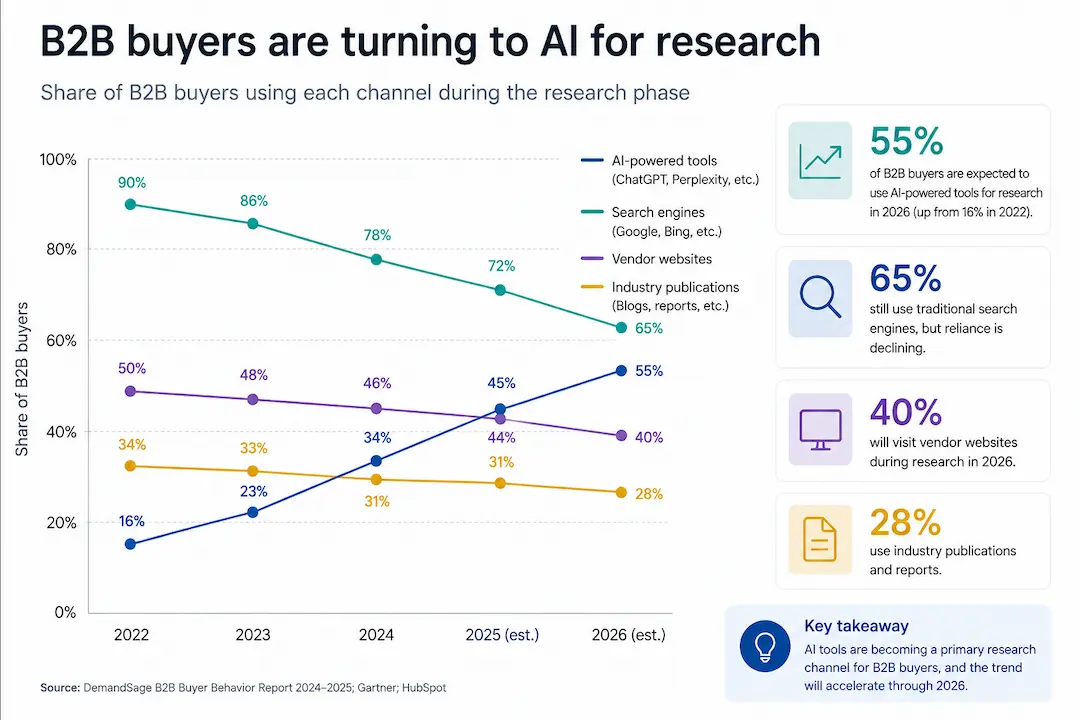
There is a real opportunity hiding in this shift, and it is bigger for B2B than for most consumer categories.
Start with intent. A keyword search like "CRM software" tells you almost nothing. A conversational query like "which CRM suits a 50-person marketing agency that needs advanced automation and Salesforce-grade reporting" tells you the buyer is deep in evaluation.
AI engines field thousands of these specific, high-intent questions, and the Stanford AI Index shows just how quickly that behaviour has gone mainstream. Being the brand named in the response means reaching buyers who are already close to a decision.
Early vendor data suggests AI-referred visitors tend to arrive with stronger intent and convert better than generic organic traffic, though the exact figures vary by source and should be read as directional rather than gospel.
Then there is timing. This looks a lot like the early days of SEO, when the brands that moved first captured visibility their slower competitors spent years trying to claw back.
The same window is open now. Most B2B competitors are still pouring effort into ranking tactics while paying little attention to whether AI engines cite them at all. That gap is your opening, and our deeper look at GEO for B2B SaaS shows how fast it is closing in some categories.
The AEO strategies that move the needle for B2B
Build authority-driven, answer-shaped content
AI models reward genuine expertise, and they recognise it through structure and language. Map the real questions your buyers ask across the journey, then answer each one directly, in their words, not in marketing speak.
Lead with the answer, support it with detail, and use clear headings so an engine can extract a clean, self-contained response.
This is also where helpful, people-first writing and AI citation behaviour line up neatly. Content written to genuinely help a buyer tends to be the same content AI engines lift. For the finer points of writing specifically to earn citations, our guide on content cited by LLMs goes deeper.
Win featured snippets and direct answers
Featured snippets behave like training data for AI systems. Content that already wins them is frequently the content that gets cited in generated answers. Structure for that outcome: concise definitions, ordered steps, short comparison blocks, and question-led headings.
Optimise at passage level rather than page level, so each chunk earns its place independently. Our walkthrough on optimising for AI Overviews covers the formats that travel best.
Implement structured data and schema
Schema markup is the bridge between human-readable content and machine interpretation. For B2B, prioritise Organisation markup for brand authority, FAQ markup for common buyer questions, and HowTo markup for process content. Our practical guide to structured data for AEO translates these into a B2B checklist.
Done well, schema helps engines parse and cite your content with confidence instead of guessing.
Turn link building into citation building
In the AEO era, the old link-building muscle becomes citation building. Mentions in credible industry publications, analyst write-ups, comparison sites and expert commentary all make your brand more citeable, because AI systems treat those references as authority signals.
Chase recognition from sources your industry already trusts rather than raw link volume. Guest content, partnerships and genuine thought leadership all feed this profile.
Strengthen entities and consistency
AI engines build a picture of your brand as an entity, and consistency sharpens it. Keep your name, positioning, key people and core topics consistent across your site, profiles and third-party mentions.
Strong entity optimisation often explains why one vendor gets cited repeatedly while a similar competitor barely registers. The same discipline underpins E-E-A-T for AEO, which AI systems lean on heavily when deciding who to trust.
Measuring AEO success
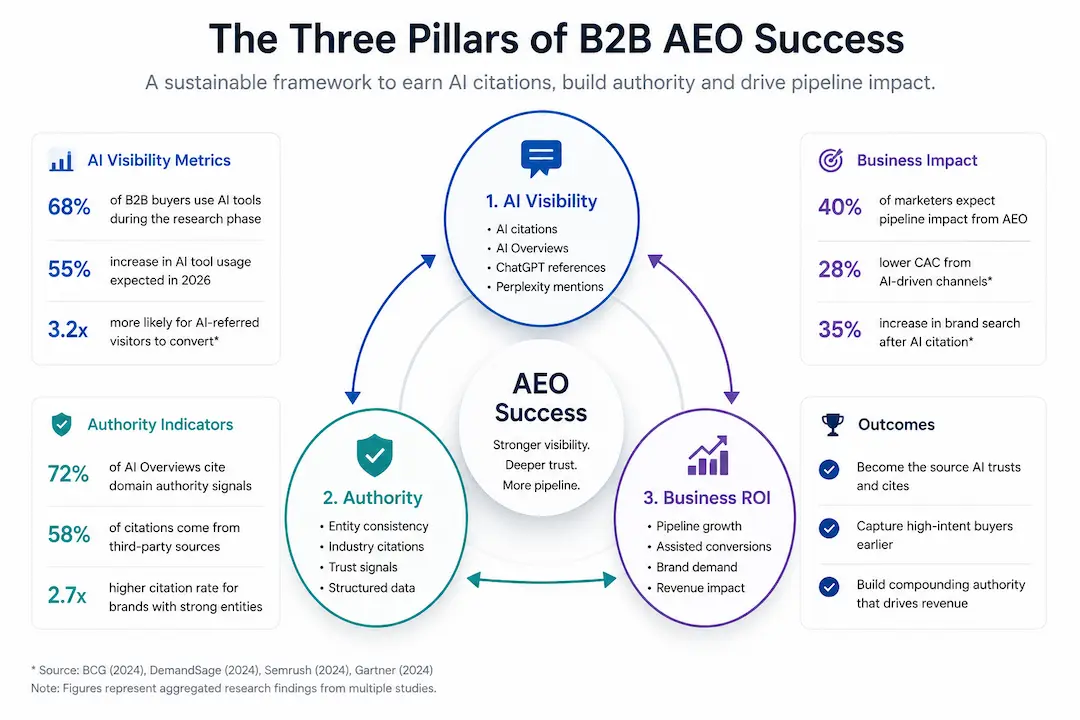
Clicks, impressions and rankings do not tell the full story in an AI-driven landscape. AEO success sits on three pillars working together.
Visibility measures how often AI systems cite your brand in generated responses. Test your target prompts regularly across ChatGPT, Perplexity and Gemini, and track citation frequency over time rather than as a one-off snapshot.
Authority reflects how algorithms judge your trustworthiness: topic coverage depth, source credibility, clean structure, and consistent entity recognition. These are the signals that decide whether you get cited once or cited consistently.
ROI connects all of it to business outcomes. Even when an AI answer drives no immediate click, it shapes awareness and credibility across the buyer journey.
Watch assisted conversions, branded search growth and engagement from AI referral sources. Our full breakdown on how to measure AEO ROI shows how to wire this into GA4 and your CRM so the numbers reach the boardroom.
A practical starting audit
You do not need a new platform to begin. Start by auditing your brand through an AI lens.
Ask the major engines the questions your prospects actually ask, including category, comparison and "best tool for X" prompts. Note which brands appear, where you sit in the answer, and how you are described.
Every prompt where a competitor is named and you are not is a content gap with a clear owner. Map those gaps, then build or restructure content specifically to fill them, written as direct answers and marked up properly.
Because AI engines respond to conversational, intent-led queries, frame everything around the problem the buyer is trying to solve, not the feature you want to sell.
Common mistakes B2B teams make with AEO
A few patterns hold teams back. Treating AEO as a one-off experiment rather than an ongoing discipline, so momentum stalls after the first sprint. Writing marketing-heavy service pages instead of clear answers, which gives engines nothing clean to lift. Bolting on schema without first fixing the content underneath it.
Chasing citation volume while ignoring whether the context is positive or accurate. And skipping competitor benchmarking, which leaves you blind to who is winning the answer in your category.
Reworking your FAQ strategy for AI models fixes several of these at once, since well-built FAQs are some of the most citeable content you can publish.
Where B2B discovery is heading
The direction of travel is clear even if the exact timeline is not. AI-assisted research is becoming a default step in B2B evaluation, and many analysts expect AI-driven discovery to rival traditional search before the end of this decade.
Buyers are forming vendor shortlists from AI summaries before they visit a single website, which means the brands cited in those summaries are quietly setting the agenda for the whole sales process.
Treat this as a strategic shift, not a tactic. The companies that fold AEO into their existing content engine, rather than running it as a side project, tend to see results faster and hold them longer.
Your expertise has always been your edge. AEO simply makes sure the AI systems your buyers now rely on recognise it as such.
If you want a clear read on where you currently stand, a free AI visibility audit is the quickest way to see which prompts already cite you and which ones do not.
Implementation checklist
Use this list to audit and improve your AI visibility after reading this guide.
- Audit how the major AI engines currently describe and cite your brand.
- Map buyer questions across the journey and answer each one directly.
- Lead every section with the answer, then support it with detail.
- Add Organisation, FAQ and HowTo schema to high-value pages.
- Keep brand name, people and core topics consistent everywhere.
- Earn mentions in trusted industry publications and comparison sites.
- Track citation frequency, sentiment and position monthly per engine.
- Connect AI visibility to assisted conversions and pipeline in your CRM.
Sources and references
Primary sources, official documentation, research and SkyScale audit data cited in this article.
- Gartner Predicts Search Engine Volume Will Drop 25% by 2026 — Gartner · February 19, 2024
- 2025 AI Index Report — Stanford HAI
- Artificial intelligence research and data — Pew Research Center
- How ChatGPT search works — OpenAI Help Center
- FAQ (FAQPage) structured data — Google Search Central
- Organization schema — Schema.org
Frequently Asked
What makes AEO different from traditional SEO?

SEO ranks web pages in search results. AEO optimises content to be cited by AI systems inside generated answers. It prioritises clarity, conversational relevance and authoritative sourcing over keyword density, and it measures success in citations rather than clicks.
How quickly can B2B companies see results from AEO?
Faster than classic SEO in many cases. When you restructure content into clear answers and add proper schema, AI engines can begin citing it within weeks rather than months. Authority and consistency, though, compound over a longer period.
How do B2B companies get cited by AI systems?
By publishing high-quality, well-structured content that answers buyer questions directly, marking it up with schema, keeping entity signals consistent, and earning mentions from credible industry sources that AI systems read as authority.
Can AEO performance actually be measured?
Yes. Track visibility (citation frequency across engines), authority (structure, sentiment and entity recognition) and ROI (assisted conversions, branded search and pipeline). Tying AI visibility to CRM data turns it into a defensible business case.
Does AEO need heavy technical work?
Some technical elements like schema help, but the foundation is editorial: clear, well-structured content that answers questions. Many gains come from content strategy changes rather than deep technical builds.
Is AEO replacing SEO for B2B?
No. It adds a layer that decides whether you are discovered in an AI-first world. The strongest B2B programs run SEO and AEO together, using the same quality content to rank pages and earn AI citations.
Authorship and review

Written by

Reviewed by
Lachlan McDonald
· AI Search & Data Engineering Reviewer
.svg)

.svg)


.svg)
.svg)
.svg)

.svg)
.svg)