HomeInsights
Elevate

AEO vs SEO: The Next Frontier in Search

AEO vs SEO explained: how answer engine optimisation differs from SEO, where GEO fits, and how to build a combined strategy so AI cites your brand as the answer in the conversational search era.

Man in white shirt and patterned vest sitting in a black leather chair at a table, resting chin on fist.

Eden John

Founder, SkyScale

5 min read

Published

December 22, 2025

Updated

June 25, 2026

Decorative

What changed in this article, June 25, 2026: merged four guides into one, clarified the SEO, AEO and GEO distinction, and refreshed the adoption, traffic and implementation guidance.

Table Of Content

Quick summary

SEO gets you ranked; AEO gets you chosen as the answer. They are not rivals. The brands that win the AI era run both, layering answer engine optimisation and generative engine optimisation on a strong SEO foundation so AI systems trust and cite them.

  • SEO ranks pages and drives clicks; AEO becomes the direct answer.
  • GEO ensures you are included and cited within AI-synthesised summaries.
  • All three share fundamentals: quality, structure, authority and trust.
  • Zero-click is rising, so measure citations and influence, not just clicks.
  • Most marketers expect AEO to matter; few have started, so act early.
Audience Icon

Who this is for

This guide is written for teams deciding how to balance SEO with AEO and GEO.

  • Marketing and SEO leads: wanting a clear, combined strategy for AI-era search.
  • Founders and content owners: future-proofing visibility as search turns conversational.
Evidence base document icon

Evidence base

Drawn from SkyScale's AEO and GEO work across 200+ audits and client programs completed between October 2024 and May 2026, alongside published industry research, across B2B SaaS, professional services and ecommerce.

Research methodology icon

Methodology

Compared client outcomes with public surveys and studies on AI search adoption and click-through behaviour, then tested category and question prompts across ChatGPT, Gemini, Perplexity and Google AI Overviews.

Limitations warning icon

Limitations

AI responses are probabilistic and the landscape shifts quickly. Results vary by model, location, device and freshness. Adoption, traffic and visibility figures vary between studies and should be treated as directional.
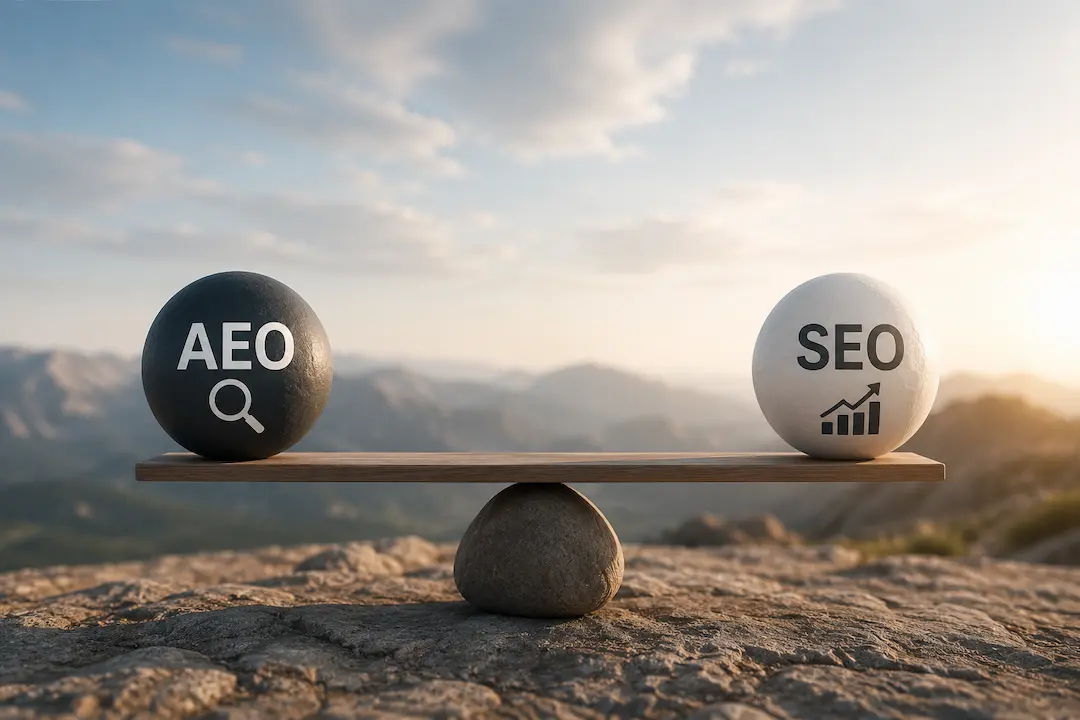
"Balanced AEO and SEO symbols on a seesaw representing the comparison between Answer Engine Optimisation and traditional search engine optimisation."

The search bar is becoming a conversation

For decades, SEO was the undisputed champion of digital visibility. Brands mastered keywords, backlinks and content to climb Google and Bing. But AI has rewritten how people find information.

The shift from text-based searches to conversational queries on ChatGPT, Google AI Overviews and voice assistants marks a fundamental change in how brands get discovered.

It is no longer just about ranking first, it is about becoming the definitive answer. In a conversation you do not rank; you either provide the answer or you are invisible. That is the heart of answer engine optimisation, and understanding how it relates to SEO is now essential rather than optional.

What is SEO

Search Engine Optimisation is the practice of improving a website to increase its visibility when people search on engines like Google and Bing, with the goal of ranking higher on the results page to attract organic traffic. Its long-standing pillars are keyword research, backlinks that build authority, technical health like speed and mobile-friendliness, quality content that satisfies intent, and a strong user experience.

Ranking still matters enormously, since the first page captures the overwhelming majority of search clicks. SEO remains the bedrock, and it is the foundation everything else builds on, as our AI in SEO guide explains.

What is AEO

Answer Engine Optimisation is the practice of structuring content so AI-powered platforms can extract direct, concise answers and cite your brand as the source, whether in Google's AI Overviews, a featured snippet, or a chatbot like ChatGPT or Copilot.

It targets a different kind of search, one that is conversational and seeks an immediate answer rather than a list of links.

AEO leans on natural language processing and machine learning to understand the context and intent behind a query, then positions your content as the most reliable source the AI chooses to feature.

The technical priorities are clarity-focused: clean structured HTML, semantic heading hierarchy, plain language, and concise question-led answers. With AEO you are not just optimising for a click, you are optimising to shape the answer itself, which is especially valuable as zero-click searches grow.

Where GEO fits: SEO vs AEO vs GEO

A third discipline completes the picture. Generative engine optimisation focuses on influencing how AI models synthesise and present information across a broader generated narrative, making sure your brand is included and favourably mentioned within an AI-constructed summary, not just cited for one direct answer.

The simplest way to hold the distinction in mind is this: SEO gets you on the shelf, AEO makes you the specific product the assistant hands to the customer, and GEO ensures you are mentioned in the "best of the year" guide. SEO ranks pages to drive traffic, AEO provides the extractable answer and earns the citation, and GEO secures inclusion in the wider AI-synthesised recommendation.

They are interconnected layers of one modern strategy, a relationship we unpack further in AEO versus GEO.

Key differences: ranking versus answering

While AEO and GEO build on SEO, their goals diverge in three important ways. The first is ranking versus answering: SEO aims for a high position in a list of links, while AEO and GEO aim to be integrated into a single, definitive AI answer.

The second is keywords versus context: SEO leans heavily on keyword optimisation, while answer and generative engines prioritise conversational intent and contextual relevance, addressing the underlying question rather than matching a phrase, which is why search intent work is central.

The third is traffic versus answers: a successful SEO strategy drives clicks to your site, while a successful AEO strategy delivers the answer within the search interface, which may reduce click-throughs but builds brand authority. SEO guides users to your website; AEO brings your answer directly to the user, wherever they are searching.

Why you need all three, not either or

This is not a story of replacement. It is about integration. An independent Acquia survey of over 500 US and UK marketers found that around 70% expect AEO to significantly reshape how their brand is discovered within one to three years, yet only about 20% have begun implementing it.

That gap is the opportunity. Brands that act now establish authority before the space gets crowded.

Running all three together maximises visibility across traditional search, AI chatbots, voice assistants and social platforms, so you meet your audience wherever they search. It also adapts you to changing behaviour, as conversational AI and voice become primary touchpoints, a shift our guide to winning voice search addresses.

A robust SEO foundation makes your content discoverable, while smart AEO and GEO ensure your expertise is selected and amplified.

How to implement an AEO and GEO strategy

Adapting does not mean abandoning SEO, it means adding layers focused on clarity, structure and authority. Start with short, structured content that is easy to parse: comprehensive FAQ pages with question-led headings, featured-snippet-ready answers, and clear how-to steps.

Open each page with a direct two to three sentence summary that answers the primary query, then use natural questions as headings and lists to break down complexity.

Layer in structured data, using schema such as Article, FAQPage, HowTo, Product and Organisation to explicitly label your content so AI can interpret and feature it accurately.

Keep your technical foundation strong, because a fast, mobile-friendly, crawlable site is easier for both humans and AI to navigate, and tools like PageSpeed Insights help you fix Core Web Vitals issues.

Then build authority and E-E-A-T with original research, expert attribution and credible mentions, since AI weighs every signal of trust, including unlinked brand mentions, a theme in E-E-A-T for AEO and content LLMs cite.

The traffic and measurement shift

The rise of AEO changes how you measure success. Because AI engines often answer directly, users may not click through, and reporting from Search Engine Land and others shows AI Overviews materially reduce organic click-through for affected queries. SEO traffic is easy to track through clicks, conversions and bounce rate, but AEO success is harder to measure directly and demands new KPIs.

Shift your focus to visibility and influence: track brand mentions and citations within AI Overviews and chatbot answers, monitor engagement from AI-driven referrals, and weigh value over volume, since visitors who do arrive from an AI answer are often further along the buyer journey and convert better.

Our breakdown of how to measure AEO ROI and a regular AI Overviews optimisation review turn this into a repeatable process.

Challenges in adopting AEO, and how to get past them

Despite its importance, organisations hit real hurdles. The Acquia research identified the biggest barriers as budget constraints, a lack of internal expertise, competing priorities, and unclear ROI, with many marketers also reporting a decline in search traffic.

None of these are insurmountable.

Reframe AEO not as a cost but as an investment in future visibility. Start small with a few high-value pages, build internal capability or partner for expertise, and replace vague ROI worries with the citation and influence metrics above.

The brands that push through the friction now will be the ones AI cites first later, supported by consistent entity optimisation and content built to be engaging for LLMs.

A combined strategy for the next era

The debate is not SEO or AEO, it is how fast you can run them together. As one widely shared AEO guide puts it, AEO and SEO are complementary, and starting with answer engine optimisation tends to improve your SEO too, because both demand high-quality, well-structured, valuable content.

Ignoring AEO is like sticking with print in the age of digital, a strategy destined to fall behind. The most resilient brands audit their content for both technical readiness and conversational clarity, then build a strategy that positions them not just to be found, but to be the answer, whether the query lands in Google, ChatGPT or Gemini.

Understanding how ChatGPT selects sources makes that strategy concrete.

Prepare for the next wave of search

The future of discovery is conversational, direct and intelligent. SEO remains the bedrock of a strong online presence, but AEO is the next frontier, and GEO extends it into the wider AI narrative.

Brands that integrate all three will not just survive the AI shift, they will thrive in it. Start by treating your website as a source of structured data for AI platforms, optimise for clarity, anticipate the questions your audience asks, and focus on becoming the most authoritative answer in your field.

Make it core to your AI search visibility, and a free AI visibility audit is the fastest way to see whether AI already chooses you.

Implementation checklist

Use this list to audit and improve your AI visibility after reading this guide.

  • Keep SEO fundamentals strong: keywords, links, speed and structure.
  • Open pages with a direct two to three sentence answer to the main query.
  • Use natural, question-led headings and scannable lists.
  • Add Article, FAQPage, HowTo, Product and Organisation schema.
  • Fix Core Web Vitals and ensure mobile-friendliness and crawlability.
  • Build E-E-A-T with original research, expert attribution and mentions.
  • Track AI citations and mentions, not just clicks and rankings.
  • Prioritise value metrics like qualified leads and conversions.

Sources and references

Primary sources, official documentation, research and SkyScale audit data cited in this article. in this article.

Frequently Asked

What is the difference between AEO and SEO?

Decorative

SEO improves a website's ranking on search engine results pages through keywords, backlinks and content. AEO structures content so AI-powered platforms can extract direct answers and cite your brand as the source, focusing on conversational queries, featured snippets and voice rather than ranked links.

Does AEO replace SEO?

Decorative

No. AEO and GEO build on SEO rather than replacing it. A strong SEO foundation makes your content discoverable, while AEO and GEO ensure your expertise is selected and cited by AI. The most effective approach runs all three together.

How is GEO different from AEO?

Decorative

AEO focuses on providing a direct, extractable answer and being cited as the source for a specific query. GEO is broader, ensuring your brand is included and favourably mentioned within a wider AI-synthesised summary or recommendation. They are complementary layers.

How do I structure my website for AI-powered search?

Decorative

Lead with concise direct answers, use question-led headings and a clear H1, H2, H3 hierarchy, add schema markup, keep the site fast and mobile-friendly, and demonstrate expertise. Clarity and structure make it easier for AI to interpret and cite your content.

How do I measure AEO success if clicks decline?

Decorative

Track visibility and influence rather than clicks alone. Monitor brand mentions and citations in AI Overviews and chatbot answers, measure engagement from AI-driven referrals, and weigh value metrics like qualified leads and conversions, since AI-referred visitors often convert well.

Which industries benefit most from AEO?

Decorative

Any industry with high volumes of direct queries benefits, with healthcare, finance, ecommerce and education often gaining the most. Becoming a trusted, citable source in these sectors builds both visibility and customer trust in AI-driven search.

Authorship and review

Man in white shirt and patterned vest sitting in a black leather chair at a table, resting chin on fist.

Written by

Eden John

· Founder, SkyScale

 LinkedIn profile

Eden leads SkyScale's Generative Engine Optimisation practice, focused on getting brands cited inside ChatGPT, Perplexity, Google AI Overviews and Gemini.

Relevant experience: Shipped 100+ AI visibility audits across B2B SaaS, professional services and ecommerce between Q4 2024 and Q1 2026, tracking citation patterns across the four major answer engines.

Credentials: Master of Business Administration (MBA) · Founder, SkyScale · 100+ AI visibility audits · GEO, AEO and AI SEO specialist

Smiling young man with curly dark hair in a maroon T-shirt crosses his arms indoors.

Reviewed by

Lachlan McDonald

· AI Search & Data Engineering Reviewer

 LinkedIn profile

Lachlan reviews SkyScale's AI search and data engineering content, focused on technical accuracy, methodology, retrieval logic, data quality and source-evaluation claims.

Relevant experience: 6 years of experience across AI search and data engineering, reviewing technical systems and source-selection claims for accuracy, reliability and methodological soundness.

Credentials: Master of Data Science · Bachelor of Software Engineering (Honours) · AI search and data engineering specialist

Last reviewed March 27, 2026
This is the block containing the Collection list that will be used to generate the "Previous" and "Next" content. You can hide this block if you want.
Ai visibility icon

AI Visibility
Report

3 business days. No credit card required, reviewed by a human.

Real Client Results

What you can expect to gain

+1,975%

more clicks from search

Benarrivati

£2,262

revenue from ChatGPT

Avenue Cookery

Google CTR lift

Vision One

+462%

more search impressions

SkyScale

See how we did it