Why doesn't ranking on Google get me into ChatGPT?
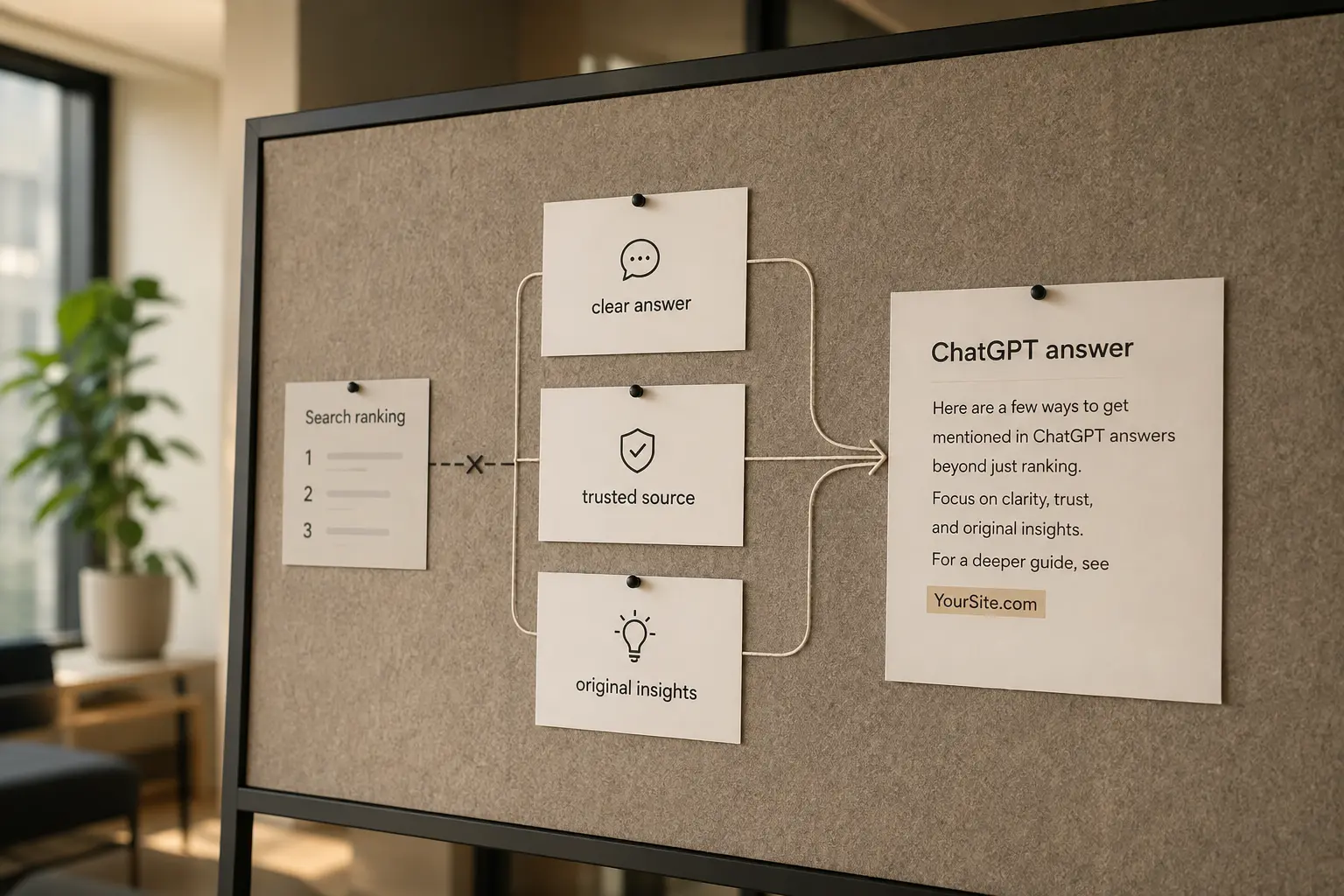
Because ChatGPT does not work like Google. It does not crawl and rank a list of pages; it answers from a trained model, and increasingly supplements that with live retrieval. As the Wikipedia overview of GPT-4 explains, the model was trained to predict text from enormous internet datasets, so its base answers come from what it learned, not from today's search rankings unless it browses.
That single fact reframes everything. Your Google position is a signal to Google's ranking system, but ChatGPT's trained memory was shaped by how often and how consistently your brand appeared across the web it learned from. A page can rank first and still be nearly invisible in that training signal, which is exactly the gap so many strong-SEO businesses fall into.
It is worth being precise about the two paths in. In its default trained mode, ChatGPT answers purely from memory, and there your Google rank is invisible to it. In its search mode it browses and can pull in current pages, and there rankings matter a little more, but only as one input among many. Most brand-name recommendations lean on the trained side, which is the one your SEO does not touch.
There is a retrieval side too, where ChatGPT search fetches live sources, and that leans a little closer to traditional signals. But even there, being named depends on being a trusted, quotable source, not on your rank. Understanding how ChatGPT selects and understands its sources is the starting point for closing the gap.
What actually gets you mentioned in ChatGPT?
Brand mentions, consensus across the web, and video, far more than backlinks or rankings. When Ahrefs studied what actually works to appear in ChatGPT, the strongest correlations were not the classic SEO ones. YouTube mentions correlated most strongly, partly because GPT-4 was trained on over a million hours of YouTube transcriptions, and branded web mentions came second, while backlinks showed extremely low correlation.
The study also found that LLMs look for consensus: when many sources describe your brand as a strong solution, the model learns to reflect that. And it confirmed ChatGPT is non deterministic, with almost no chance of returning the same brand list twice, so the goal is raising your frequency of appearing, not securing a fixed rank.
Here is the contrast that catches most SEO teams off guard:
| Moves ChatGPT mentions |
Barely moves them |
| Branded mentions across many sites |
Backlinks and domain rating |
| YouTube and video presence |
Your Google ranking position |
| Consensus describing you as a top option |
A single well-optimised page |
| Quotable, self-contained answers |
Keyword-stuffed content |
The lesson is not to abandon SEO, which still feeds the retrieval side and your wider presence. It is to recognise that being mentioned runs on brand signals, and to build those deliberately through entity and topical authority for AI search.
What makes this hard for SEO teams is that the two systems reward almost opposite things. Google rewards a single, tightly optimised page with strong links. ChatGPT rewards a brand that shows up everywhere, described the same way, with or without links. You are not tuning the same machine harder, you are feeding a different one, and the sooner that clicks, the sooner the effort starts paying off.
Why do brand mentions matter more than backlinks?
Because ChatGPT learns who you are from what the web says about you, and mentions are that raw material. Ahrefs analysed 9.6 million ChatGPT queries and found in its work on PR and brand mentions for ChatGPT visibility that brand mentions correlate strongly with AI visibility, and that being featured on the publications ChatGPT already cites raises your odds of appearing in its answers.
Crucially, many of these mentions carry no link at all. A model can absorb your brand from an article, a comparison piece or a video transcript without a single hyperlink, which is why a link-first strategy underperforms here and a mention-first one wins. The same research made a blunt point: being visible in Google is not enough on its own.
This is why digital PR and earned mentions have quietly become AI visibility work. Every credible place your brand is named, described consistently and grouped with the category leaders adds to the consensus ChatGPT reflects. It is the durable engine behind how answer engine optimisation builds brand trust.
The mental shift is from earning links to earning language. What you want is for credible sources to write your brand name, in your category, in the same breath as the outcomes buyers care about, because that is what a model reads and generalises from. A single feature in a publication ChatGPT already trusts can do more for your mentions than months of link building aimed purely at Google.
How do you write content ChatGPT will quote?
Lead with a tight, self-contained answer that a model can lift without context. Search Engine Land's audit of the content traits LLMs quote most found that answer capsules, roughly 120 to 150 character self-contained answers placed right after question-based headings, were the single strongest trait of cited posts, appearing in over 70% of them, and that adding original or branded data lifted citation rates further.
One finding surprises people: more than nine in ten of those cited capsules contained no links, because links suggest the answer lives elsewhere and dilute quotability. The move is to answer the question fully, in place, in your own words, and let the model take it whole.
There is a discipline in this that good writers resist at first. It feels redundant to answer a question fully at the top when the depth is right below, and it feels wrong to leave out a helpful link. But you are writing for two readers now, a person who scrolls and a model that extracts, and the answer capsule serves both. Lead with the answer, earn the read, and keep it liftable.
Structure and freshness reinforce it. Semrush's guide to answer engine optimisation points to clear question-based structure, schema markup and recency, noting that the vast majority of ChatGPT citations come from content published or updated recently.
Writing pages engineered this way is the craft behind content that gets cited by LLMs, and marking it up cleanly is where structured data for answer engine optimisation earns its place.
Does video help you get mentioned in ChatGPT?
Yes, more than most SEO teams expect, because video feeds the model directly. Since GPT-4 was trained on a vast amount of YouTube transcription, a clear, well-titled video answering a real buyer question can plant your brand in exactly the training signal ChatGPT draws on. The correlation data puts YouTube at the top for a reason.
This does not replace written content, which still does the heavy lifting across ChatGPT and the wider web. It adds a format that compounds your brand mentions in a place the model weighs heavily, and most competitors are not doing it.
The same discipline applies to a video as to a page: answer one important question clearly, title and describe it well, and back it with something original. A handful of well-targeted videos on your highest-intent topics can shift your ChatGPT presence more than another dozen blog posts.
The reason this works is mechanical, not trendy. A transcript is just text to the model, and a video that clearly states your brand as the answer to a question becomes exactly the kind of consistent, quotable signal the training process rewards. You do not need production polish, you need clarity: a real question, a direct answer, your brand named, and a description that spells it out.
Why does being mentioned actually matter?
Because a huge share of ChatGPT use is people asking for guidance, and the brands it names win the introduction. OpenAI's own research on how people are using ChatGPT found that roughly half of all use is "asking", seeking advice and information, with three-quarters of conversations focused on practical guidance. When a buyer asks which provider to choose, the names in the answer are the shortlist.
That is the commercial stakes in one line. Being mentioned in ChatGPT is being on the shortlist at the exact moment a buyer is deciding, often before they have visited a single website. Ranking on Google matters less when the decision is being shaped inside an assistant that never showed your result.
The way we frame it for clients at SkyScale is that ChatGPT has quietly become a recommendation engine, and recommendation engines reward reputation, not rankings. The businesses winning mentions are the ones the web already agrees are a strong choice, and that agreement is something you build on purpose rather than optimise your way into.
Your presence across Perplexity and Gemini runs on related signals, so this work compounds, though each platform has quirks. Reddit, for instance, is one of ChatGPT's most-cited sources yet barely features on some others, a reminder to check each platform rather than assume.
A structured AI visibility audit shows you exactly where you stand on each.
The plan to get mentioned in ChatGPT
Put it together and the sequence is clear. First, build brand mentions across the credible sites and publications your buyers and ChatGPT both read, through genuine digital PR. Second, pursue consensus, being described consistently as a strong option wherever you appear. Third, add video on your most important buyer questions.
Fourth, rewrite your key pages answer-first, with self-contained, link-free answer capsules backed by original data. Fifth, keep them fresh, since recency strongly favours citation. Do those five and you shift from invisible to named. Our case study on becoming a recommended brand shows the arc, and pairing this with a full generative engine optimisation programme is how it compounds across every assistant.
Common mistakes when chasing ChatGPT mentions
The biggest mistake is assuming Google rankings will carry over, when the data shows they barely correlate with being mentioned. The second is chasing backlinks instead of mentions, optimising the signal ChatGPT weighs least.
These mistakes share a root cause, which is treating ChatGPT as another search engine to rank in. It is not a ranking system, it is a recall system, and recall is earned through presence and consensus over time. Once you stop trying to rank and start trying to be known, the tactics reorganise themselves and the effort finally points in the right direction.
The third is burying your answers under preamble and links, when quotable, link-free capsules are what get lifted. The fourth is ignoring video despite its outsized influence on the model. And the fifth is expecting a fixed result from a non deterministic system, rather than steadily raising your odds. Fix those and mentions become a repeatable outcome, which is the whole aim of a serious answer engine optimisation approach.


.svg)
.svg)
.svg)
.svg)
.svg)



.svg)

.svg)


.svg)
.svg)
.svg)
.svg)