How does Perplexity decide what to cite?
Perplexity cites by searching the live web for each query, then synthesising an answer from the sources it judges most relevant and authoritative. Unlike a model relying on training memory, it works in real time, which is why it is best understood as an answer engine rather than a chatbot.
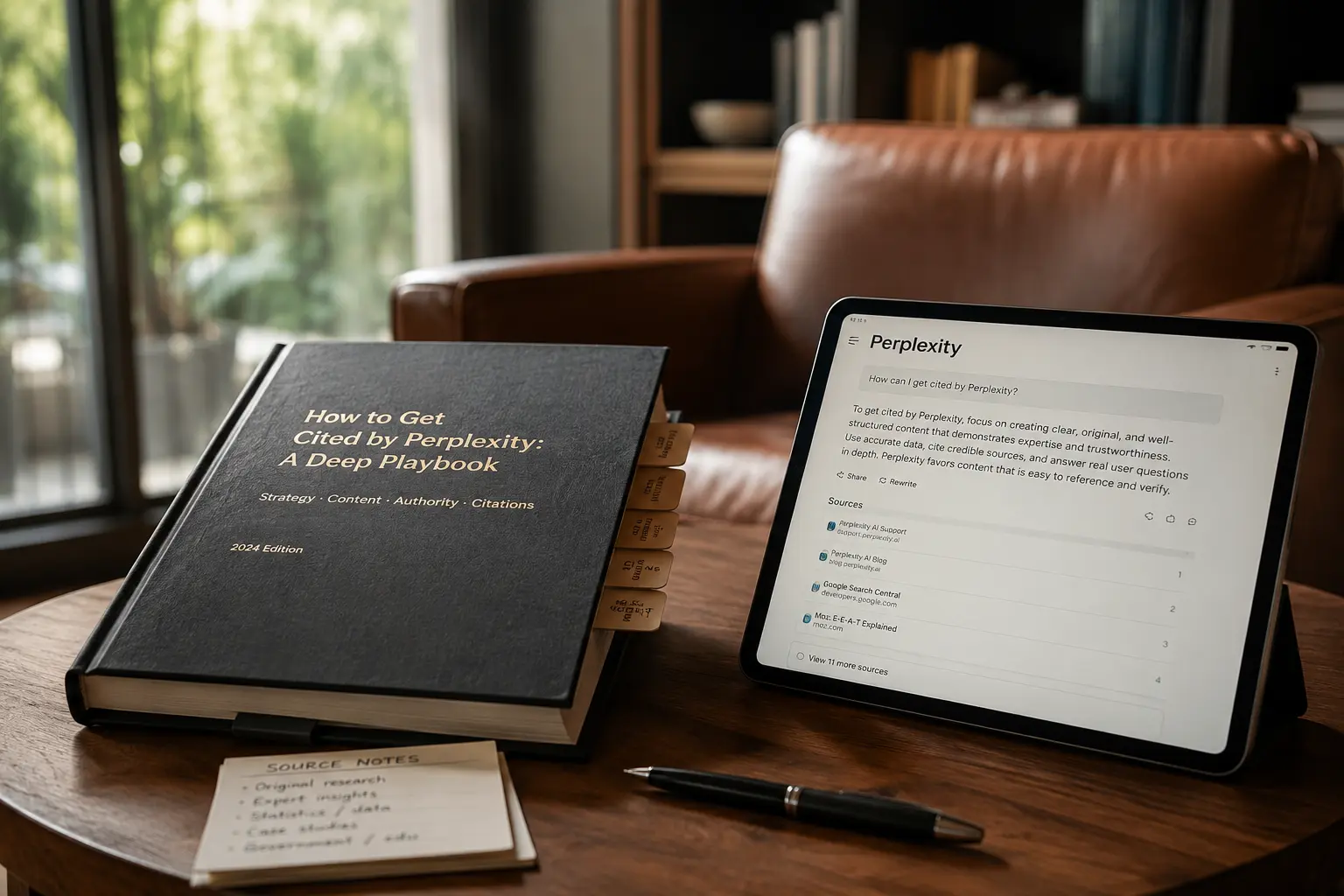
According to Perplexity's own explanation of how it works, it interprets your question, searches the internet for authoritative sources, synthesises the findings, and attaches numbered citations so users can verify each claim.
That real-time, cited design is the whole reason a citation strategy is even possible. Because Perplexity is a web search engine that synthesises current internet content rather than answering from a frozen model, being retrievable and relevant right now matters more than it does anywhere else.
The practical implication is direct: to be cited, you have to be one of the sources Perplexity finds, trusts and pulls in at answer time. That breaks into three jobs, being reachable, being authoritative, and being structured for clean extraction, and the businesses that win do all three.
Understanding how AI systems select their sources is the foundation the rest of this playbook builds on.
It is worth sitting with how different this is from classic SEO. There is no ranking position to climb and no ten blue links to fight over; there is a single synthesised answer with a handful of numbered sources beside it.
You are not trying to be the best result on a page a user scrolls, you are trying to be one of the few sources the model judged worth quoting. That is a narrower target, and it rewards a different kind of preparation.
What does Perplexity actually cite most?
High-authority domains, and some source types that surprise most marketers. Ahrefs analysed Perplexity's citations and the most-cited websites in Perplexity revealed a video-first bias, with YouTube taking roughly a third of all mention share, far more concentrated than any other assistant studied.
Reference sites like Wikipedia and dictionaries rank highly, e-commerce platforms feature heavily on product queries, and most cited domains carry very high Domain Rating scores.
The most useful finding is what is missing. Reddit, which dominates citations on some other assistants, was notably absent from Perplexity's top 50, a reminder that citation strategy is platform-specific and that copying your ChatGPT approach wholesale can misfire here.
Here is the shape of what Perplexity tends to favour and deprioritise, based on that data:
| Perplexity tends to favour |
Perplexity tends to deprioritise |
| High-authority domains (DR 85-100) |
Low-authority or thin sites |
| Video content, especially YouTube |
Content with no fresh signal |
| Reference and knowledge sites |
Reddit and forum threads (vs other assistants) |
| Recently updated pages |
Static, unmaintained pages |
The takeaway is not to chase any single row, but to recognise that Perplexity rewards established credibility and recency, and that a video presence is worth more here than most playbooks admit.
None of this means the surprising rows are quirks to game. The through-line is credibility: YouTube and reference sites both carry strong trust and authority signals, and Perplexity leaning on them reflects a system reaching for sources it can stand behind.
Read the data as a description of what trusted, current, easily-parsed content looks like to Perplexity, and the individual rankings matter far less than the pattern they trace.
Is PerplexityBot even able to reach you?
This is the first gate, and the one most sites fail without knowing. If Perplexity's crawler cannot reach your pages, nothing else in this playbook matters, because a page it never fetches can never be cited. Confirm you are reachable before you optimise anything.
The reason this trips so many businesses is that the block is usually invisible. A managed host, a firewall, or a bot-protection rule can turn PerplexityBot away while your site looks perfectly healthy to you, and you only notice the absence of citations you cannot explain.
Checking your server logs for PerplexityBot and confirming it gets a clean response is a five-minute job that saves months of wasted content effort.
Perplexity documents its crawlers clearly. The Perplexity bot documentation explains that PerplexityBot indexes sites to surface them in Perplexity search, and should be allowed via robots.txt with its IP ranges whitelisted, while Perplexity-User is a user-triggered fetcher.
Blocking PerplexityBot, whether deliberately or by an over-broad security rule, quietly removes you from consideration.
There is an honesty point worth flagging here. Cloudflare's investigation found Perplexity using stealth, undeclared crawlers that ignored robots.txt on test domains, which drew real criticism.
For your purposes it changes little: your goal is to be found, so you want the declared crawler welcomed, verified by its published IP ranges, and never accidentally blocked. If you suspect a hidden block anywhere in your stack, a structured AI visibility audit is the fastest way to confirm you are reachable.
How do you structure content Perplexity will lift?
Write answer-first, so the response to a question sits right at the top, clean and self-contained.
Perplexity synthesises answers by extracting the most relevant passages, so content that leads with a tight, direct answer is far easier to lift than an answer buried under preamble.
Semrush's guidance on optimising content for AI search engines puts the answer-first block at roughly 40 to 60 words, followed by the supporting depth.
That answer-first block does double duty. The same tight, direct answer that Perplexity lifts is also what wins a Google featured snippet, and snippets themselves often become source material for AI answers, which is why optimising for AI Overviews and featured snippets and optimising for Perplexity pull in the same direction.
Write the answer once, and write it well, and it works in several places at once.
Beyond structure, the same guidance points to credible authorship, genuine freshness, and schema markup as the signals that improve citation odds.
Marking your content up so machines parse it cleanly is where structured data for answer engine optimisation earns its place, and writing pages engineered to be quoted is the craft behind content that gets cited by LLMs.
The principle tying it together is to make the extraction effortless. A clear question in the heading, a direct answer beneath it, supporting evidence below, and clean markup around it is a format Perplexity can lift without friction. This is the heart of a serious answer engine optimisation approach, and it works across every assistant, not just this one.
Why do authority and freshness matter so much here?
Because Perplexity is choosing sources to trust in real time, and it leans on the same credibility signals a careful researcher would.
The dominance of very high Domain Rating sites in its citations is not an accident; it reflects a system that favours established authority when deciding whose claim to repeat. Building that standing is the long game behind entity and topical authority for AI search.
Freshness is the second lever, and an unusually strong one on Perplexity. Its citation rankings shift month to month, which tells you it re-evaluates sources continually rather than resting on old favourites.
A page updated to stay current has a real edge over an identical page left to age, especially in fast-moving categories.
Authority you build slowly, but freshness you can act on this week. Keeping your best pages genuinely current, not just re-dated, is one of the highest-return moves available for Perplexity visibility, and it compounds with the authority work rather than competing with it.
The way we frame it for clients at SkyScale is that Perplexity is unusually honest about what it wants. It tells you it searches live, favours authority, and refreshes constantly, so the strategy is simply to be the reachable, credible, current source it is already looking for, rather than to outwit it. There is no algorithm to trick here, only a careful researcher's standards to meet.
Should you invest in video for Perplexity?
If your buyers are on Perplexity, video deserves a real place in your plan, because YouTube's share of Perplexity citations is too large to ignore.
A third of mention share concentrated in one video platform is a signal, not noise, and it means a well-made, well-described video answering a buyer question can earn citations that a text page might not.
This does not mean abandoning written content, which still carries the bulk of the work across ChatGPT and Gemini and the wider web.
It means recognising that Perplexity's mix is different, and that a video layer on your most important topics is a lever most competitors are not pulling. Your standing in Perplexity specifically rewards it more than most.
Treat it as complementary. The same answer-first, authoritative thinking applies to a video and its description as to a page, so you are extending your approach to a new format Perplexity clearly values, not starting from scratch.
There is a practical wrinkle worth naming.
Video is more expensive to produce than a page, so the move is not to film everything, but to identify the handful of high-intent buyer questions where a Perplexity citation would matter most and answer those on video, with a clear title and a thorough description. A few well-targeted videos beat a library of thin ones, here as everywhere.
The Perplexity citation playbook, step by step
Put it together and the sequence is clear. First, confirm PerplexityBot can reach you and is not blocked anywhere in your stack.
Second, build genuine authority so you are the kind of high-credibility source Perplexity favours. Third, structure your content answer-first with clean markup so it lifts easily.
Fourth, keep your key pages genuinely fresh, since Perplexity re-weights sources continually. Fifth, add video on your most important buyer questions, because the data says Perplexity leans on it heavily.
Do those five, in that order, and you move from invisible to citable. Our case study on becoming a cited source shows the arc, and pairing this with a full generative engine optimisation programme is how it compounds.
Common mistakes when chasing Perplexity citations
The biggest mistake is optimising content while a crawler block silently keeps Perplexity out, so reachability always comes first. The second is copying a ChatGPT or Reddit-heavy strategy wholesale, when Perplexity's citation mix is genuinely different and rewards different sources.
The third is treating freshness as re-dating a page rather than actually improving it, which the system sees through. The fourth is ignoring video despite its outsized share of citations.
And the fifth is expecting guarantees from a non deterministic system, when the honest goal is to shift the odds strongly in your favour over time, not to force a single result. Get the fundamentals right and Perplexity citations become a repeatable outcome rather than a lucky one.


.svg)
.svg)
.svg)
.svg)
.svg)



.svg)

.svg)


.svg)
.svg)
.svg)
.svg)
.svg)