.svg)
Quick summary
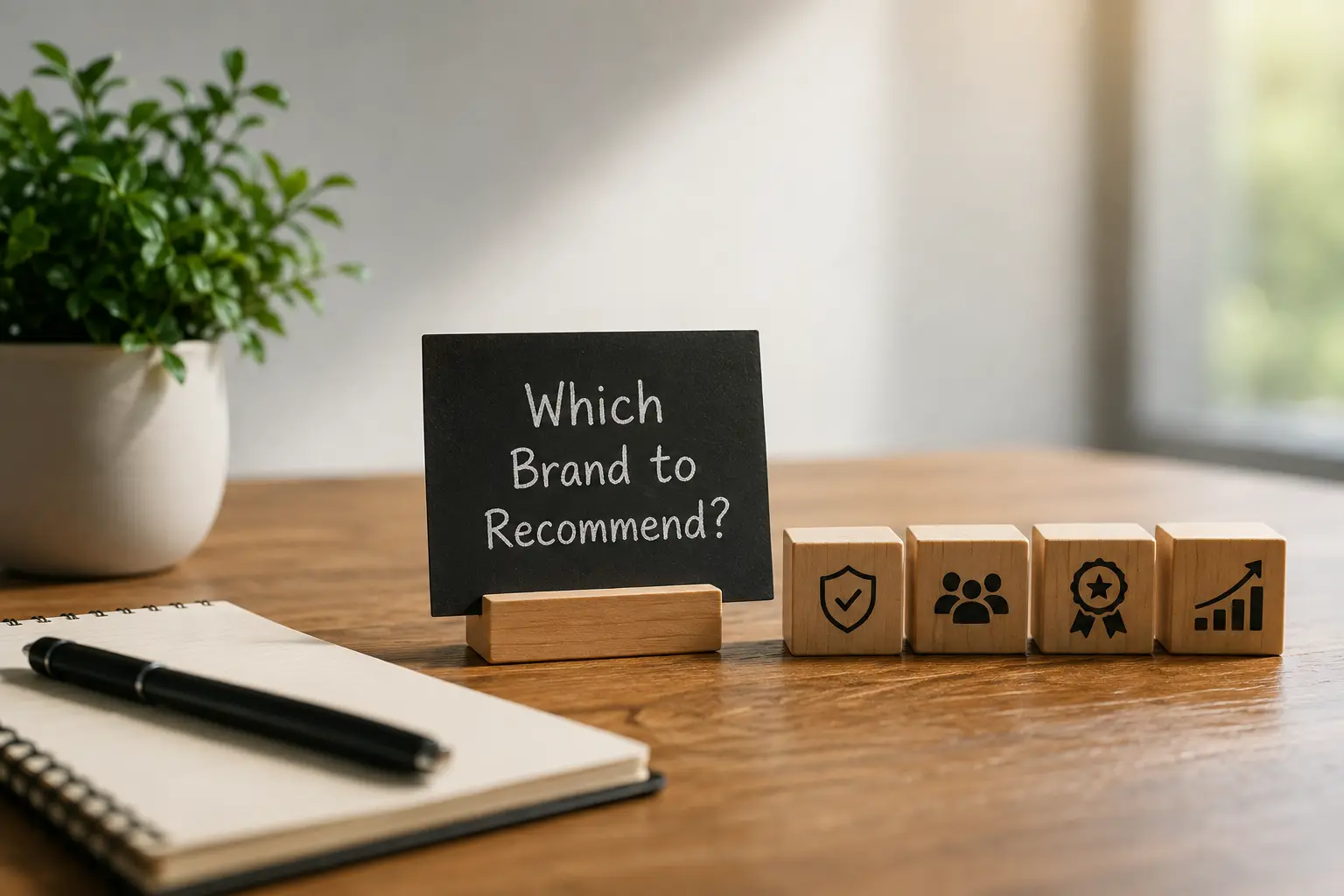
LLMs decide which brands to recommend using two kinds of memory: what they absorbed during training, and what they retrieve live at answer time. Both are matched by comparing meaning as vectors, and both reward brands that are described consistently and often across the web. It is a mechanism, not a lottery, and every part of it responds to signals you can shape.
- LLMs blend trained memory with live retrieval to answer
- Your brand exists inside the model as a pattern learned from text
- Meaning is compared as vectors, so consistency sharpens your signal
- Retrieval favours content that closely matches the query
- Frequent, consistent mentions make a brand the confident answer
.svg)
Who this is for
This is for marketers and owners who want to understand why AI recommends one brand over another, so their strategy targets the real mechanism instead of guesswork.
- Marketers tired of contradictory advice who want the underlying logic
- Owners deciding where to invest to become the recommended brand
.svg)
Evidence base
Across 200+ AI visibility audits we ran between October 2024 and July 2026, the brands that AI recommended consistently shared the same traits the mechanism predicts: they were described the same way everywhere, mentioned often, and tied clearly to their category. The invisible ones almost always had a weak or contradictory presence in exactly the places the mechanism draws on.
.svg)
Methodology
We mapped how the major assistants produce recommendations against the documented workings of language models and retrieval systems, then checked which real-world signals moved a brand from absent to recommended in our audits. The explanation below reflects both the technical mechanism and what actually shifted outcomes.
.svg)
Limitations
The exact internals of each commercial model are proprietary and evolving, so this describes the well-documented general mechanism rather than any single system's secret recipe. Models are also non deterministic, so the same question can yield different brands on different runs. We describe the forces that shift the odds, not a guaranteed output.
Implementation checklist
Use this list to audit and improve your AI visibility after reading this guide.
- Build a consistent brand presence across the web, not just your own site
- Describe your name, category and value identically everywhere
- Publish content that closely matches the questions buyers actually ask
- Earn mentions in credible sources the wider web trusts
- Fix contradictory facts that blur your brand's vector
- Demonstrate real experience and expertise, not just claims
- Structure pages so answers can be lifted cleanly into a response
- Audit where you are weak: trained memory, retrieval, or consistency
Sources and references
Primary sources, official documentation, research and SkyScale audit data cited in this article.
- Language model — Wikipedia
- Retrieval-Augmented Generation for Knowledge-Intensive NLP Tasks — arXiv
- Word embedding — Wikipedia
- Brand depth determines what AI systems recommend — Search Engine Land
- What is retrieval-augmented generation? — IBM
- Vector database — Wikipedia
Frequently Asked
How do LLMs decide which brands to recommend?

They combine two forms of memory: patterns learned during training and information retrieved live at answer time. Both turn language into vectors and favour the brand whose signals are strongest, most relevant to the query, and most consistent across the web. It is a mechanical process that responds to signals you can shape, not a random choice.
Does my own website decide whether AI recommends me?
Only partly. Your site matters, but the mechanism draws heavily on the wider web, so what others say about you, and how consistently, often matters as much as your own pages. A brand mentioned coherently across many credible sources builds a stronger signal than one relying on its own site alone.
Why does AI recommend competitors instead of me?
Usually because their signal is stronger in the mechanism: they appear more often, are described more consistently, and match buyer queries more closely than you do. The model reaches for the brand it knows best and can retrieve most relevantly, so closing that gap means strengthening your presence, consistency and content.
What is retrieval-augmented generation in simple terms?
RAG is when an AI fetches relevant documents at answer time and uses them to ground its response, rather than relying only on training memory. Your query is matched to content by vector similarity, and the closest, most relevant material gets pulled in. It is a second route to being mentioned, open to whoever matches the question best.
Can I control how LLMs see my brand?
You cannot edit the model directly, but you strongly influence its inputs. By keeping your brand's description consistent everywhere, earning credible mentions, and publishing content that matches real queries, you sharpen the signal the mechanism measures. That is the practical lever, and it works across every assistant at once because they share the same underlying mechanism.
Is being recommended by AI just about keywords?
No. Keywords barely feature in the mechanism. What matters is consistent, frequent, authoritative presence and content that genuinely matches buyer intent as vectors, not repeated phrases. Keyword stuffing does nothing, because the model compares meaning, not exact words, and rewards brands that are coherently known rather than mechanically optimised.
Authorship and review

Written by

Reviewed by
Lachlan McDonald
· AI Search & Data Engineering Reviewer
.svg)

.svg)


.svg)
.svg)
.svg)
.svg)
.svg)