.svg)
Quick summary
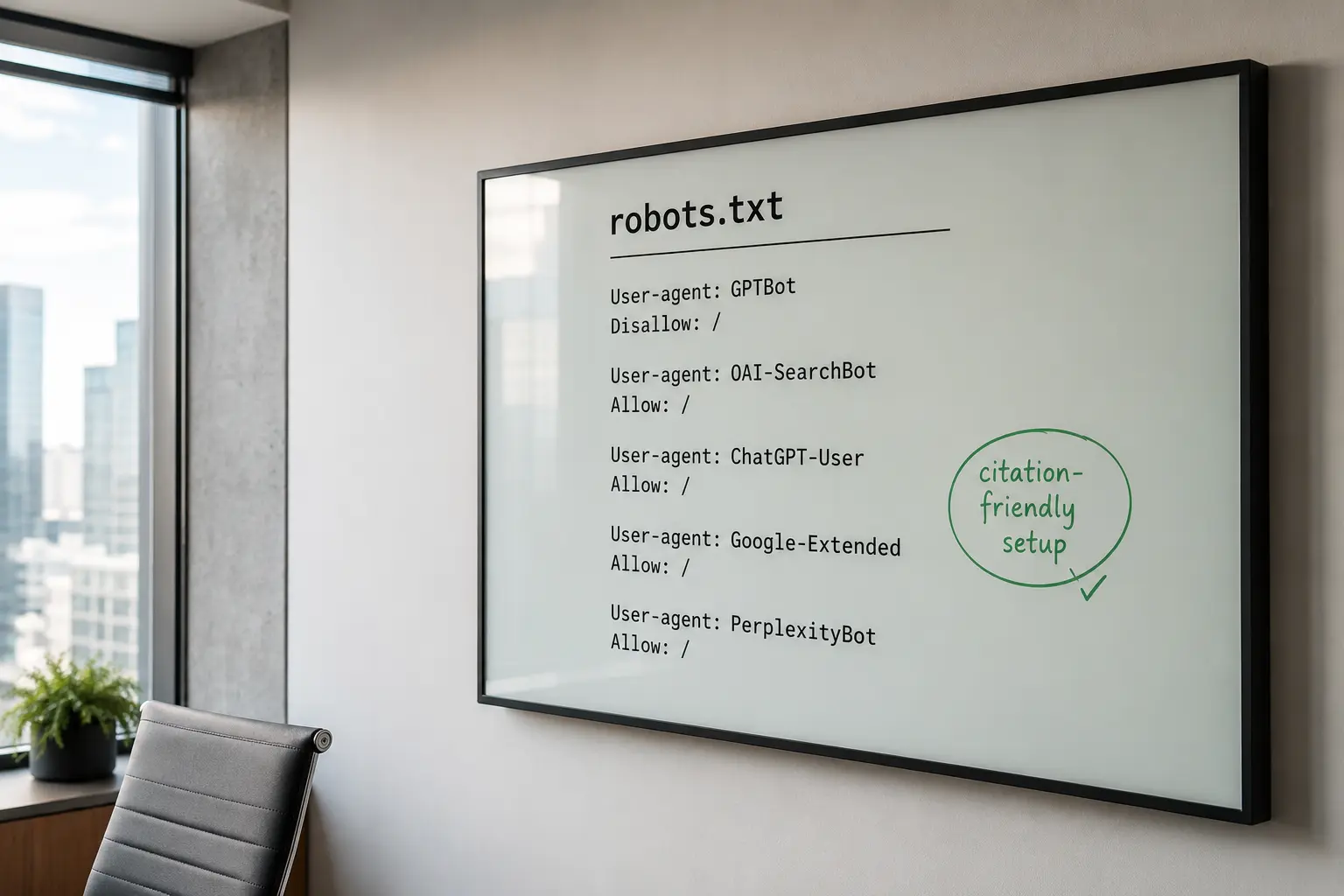
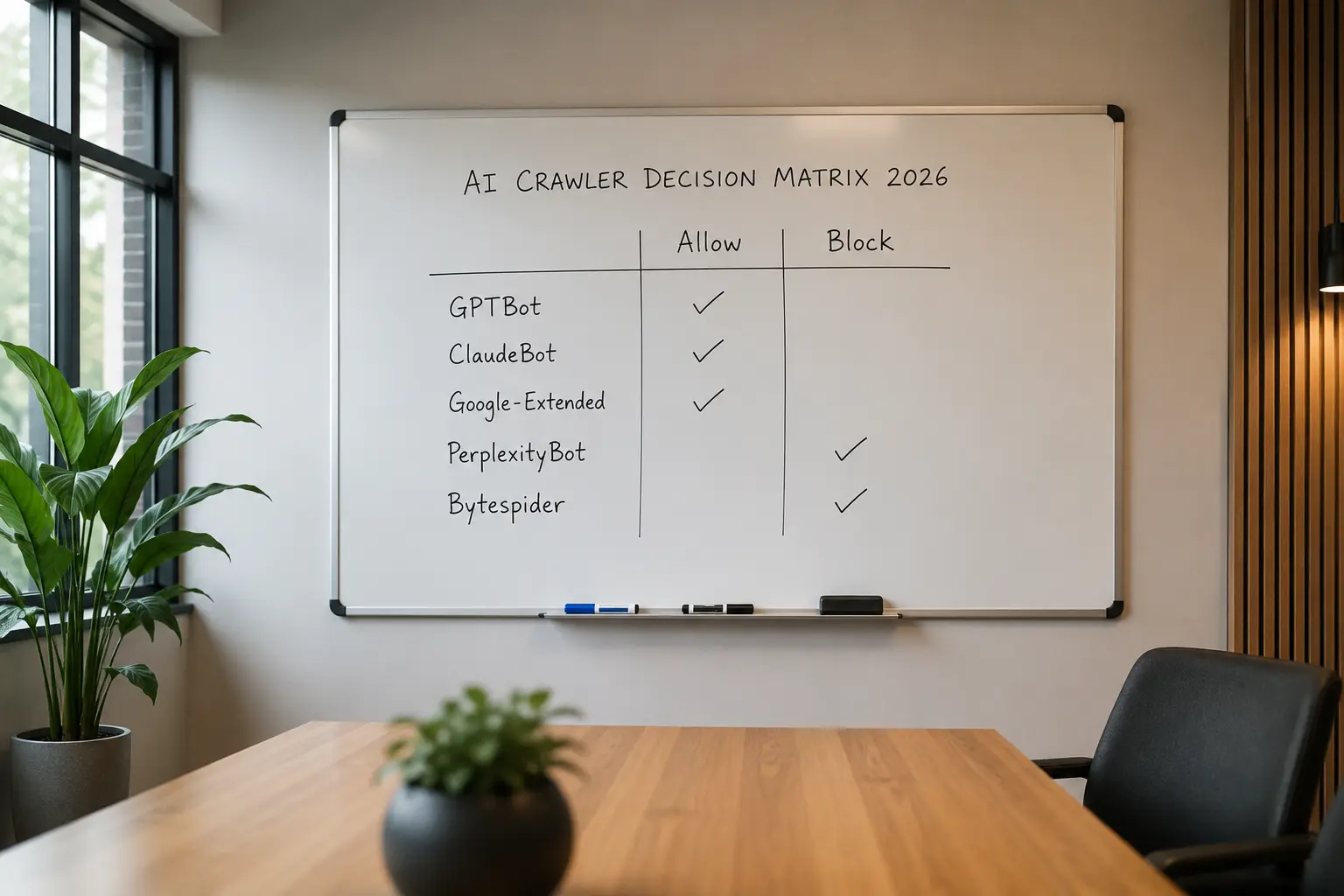
The block-or-allow question has a wrong answer at both extremes. Blocking every AI crawler removes you from AI search; allowing every one feeds training models that rarely send anything back. The right move is granular: block the training crawlers that take without returning traffic, and keep the search crawlers that put you in front of buyers.
- AI crawlers split into training, search and user-fetch bots
- Training bots crawl heavily and refer almost no traffic
- Search bots are how you appear in AI answers, so keep them
- Blocking all AI bots is the costly mistake many made in 2024
- Your decision depends on whether content is your product
.svg)
Who this is for
This is for owners, marketers and technical leads deciding what to put in their robots.txt, who want a reasoned answer rather than a blanket rule copied from a forum.
- Marketers who need to stay visible in AI answers without giving everything away
- Technical leads weighing content protection against AI search reach
.svg)
Evidence base
Across 200+ AI visibility audits we ran between October 2024 and June 2026, one of the most common self inflicted wounds was a robots.txt that blocked the very crawlers a business needed to be found by. Owners had reached for a blanket block to protect their content and quietly removed themselves from AI search in the process, usually without realising the two were different decisions.
.svg)
Methodology
We reviewed how each major AI provider names and separates its crawlers, matched those against what independent traffic data shows each one actually does, and built the decision logic below from what consistently served businesses best given their goals. The aim is a framework you can apply to your own robots.txt, not a one size rule.
.svg)
Limitations
The crawler landscape changes fast, new bots appear and providers rename or split existing ones, so treat the specific names here as current examples rather than a permanent list. Robots.txt is also advisory, not enforcement, so the guidance below assumes well behaved crawlers and pairs with other controls where genuine protection is needed.
Implementation checklist
Use this list to audit and improve your AI visibility after reading this guide.
- List every AI crawler currently hitting your site from your server logs
- Sort them into training, search and user-fetch categories
- Allow the AI search crawlers so you stay visible in AI answers
- Block pure training crawlers only if content protection genuinely matters
- Decide page by page for proprietary or premium sections
- Keep the robots.txt file simple and avoid over-restricting
- Pair blocks with page-level directives where real exclusion is needed
- Re-test and review the file as part of every technical audit
Sources and references
Primary sources, official documentation, research and SkyScale audit data cited in this article.
- The crawl-to-click gap: data on AI bots, training and referrals — Cloudflare
- AI crawlers: what are LLM and AI search crawlers and bots? — Search Engine Land
- Anthropic's Claude bots make robots.txt decisions more granular — Search Engine Journal
- CCBot documentation — Common Crawl
- Web crawler — Wikipedia
- Robots.txt and SEO: what you need to know in 2026 — Search Engine Land
Frequently Asked
Should I block AI crawlers or allow them?

It depends on the crawler. Block the training crawlers that take your content to train models and send almost no traffic back, but allow the AI search crawlers that index your pages so you can be cited in AI answers. Blocking everything is usually a mistake, because it removes you from the AI search results most businesses want to appear in.
What is the difference between a training crawler and a search crawler?
A training crawler, such as GPTBot or ClaudeBot, gathers content to train a model. A search crawler, such as OAI-SearchBot or Claude-SearchBot, indexes your pages so an assistant can cite them when answering a question. They are separate bots you can control separately, and they have opposite implications for your visibility.
Will blocking AI crawlers protect my content?
Only partially, and only from well behaved bots. Robots.txt is advisory, so compliant crawlers will respect it but others may ignore it, and blocking a crawler does not remove already-trained content from a model. For genuine protection you need real access controls, not just a robots.txt rule.
Does blocking AI bots hurt my SEO or AI visibility?
Blocking training bots generally does not hurt your visibility. Blocking search bots does, because those are the crawlers that let you appear in AI answers. Many businesses that blocked all AI crawlers in 2024 unintentionally removed themselves from AI search, which became costly as that traffic grew.
Can I block some AI crawlers and allow others?
Yes, and that is the recommended approach. Because providers now name their training, search and user-fetch bots separately, you can disallow one while allowing another in the same robots.txt file. That granularity is what lets you protect your content from training while staying visible in AI search.
How often should I review my robots.txt for AI crawlers?
Review it as part of your regular technical audits, at least a few times a year. The crawler landscape changes quickly as providers add, rename or split bots, so a file written a year ago may be blocking the wrong things. Re-testing after any change is essential, since a wrong rule fails silently.
Authorship and review

Written by

Reviewed by
Lachlan McDonald
· AI Search & Data Engineering Reviewer
.svg)

.svg)


.svg)
.svg)
.svg)

.svg)
.svg)