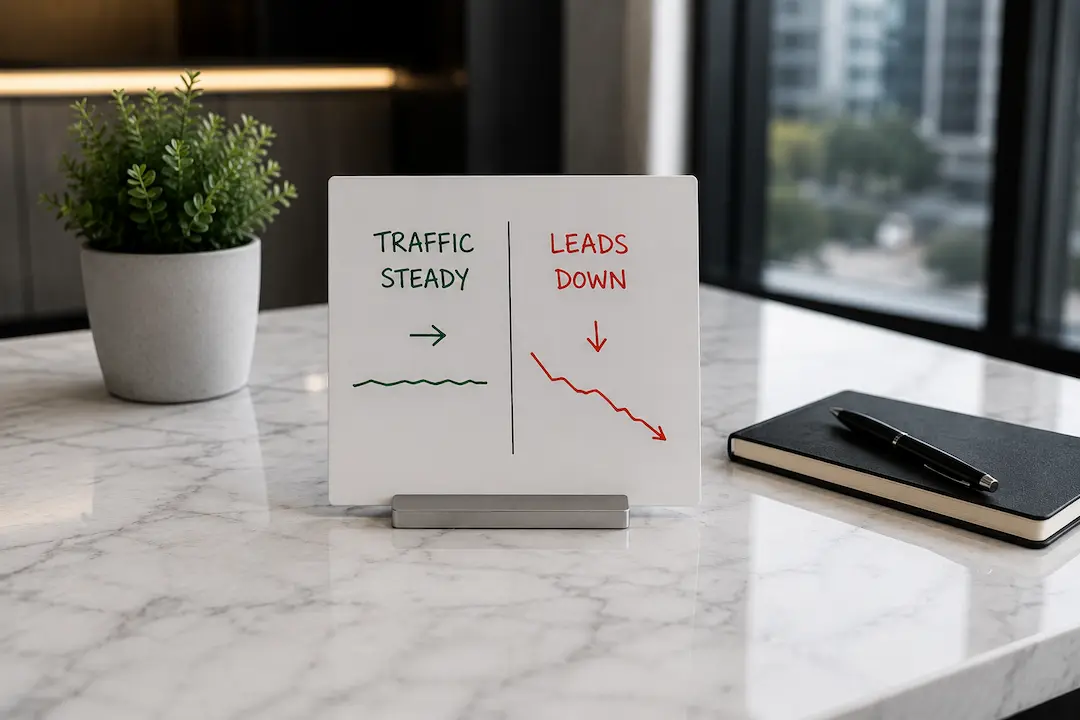
Why the old lead engine is breaking
Most lead engines share one hidden assumption: that ranking earns a click, and the click starts the relationship. For two decades that held, so businesses built content, forms and nurture flows on top of it. AI search is quietly pulling that foundation out.
When an answer sits above your result and satisfies the searcher, the click that used to feed your funnel never happens. The machinery downstream still works, the landing pages, the forms, the follow-up, but less and less flows into it. As the pain puts it, the whole engine was built on clicks that no longer happen, and no amount of tuning the downstream parts fixes a starved top.
This is not a temporary dip to wait out. Harvard Business Review describes how AI is upending marketing on two fronts, changing both how content is made and how customers discover businesses.
When discovery itself changes, patching the old engine is not enough. The engine needs rebuilding, and that starts with a new understanding of what actually drives a lead now.
The temptation is to treat the shortfall as a marketing effort problem and simply do more of the old thing: publish more posts, chase more rankings, spend more on ads to plug the gap. That instinct is expensive and usually disappointing, because it pours fuel into an engine whose intake has narrowed.
The businesses that struggle longest are the ones that keep optimising a click-based machine in a world that increasingly answers before the click. The ones that recover are those willing to question the machine itself.
The new currency: citations, not clicks
In AI search, the unit of visibility has shifted. It used to be the click, the moment someone chose your result. Now it is the citation, the moment an AI names or draws on you while answering. The citation is where influence happens, often before any click occurs, and increasingly it is where the buying decision is quietly shaped.
Citations are real and trackable, not abstract. OpenAI's own description of how ChatGPT search cites sources shows answers linking to the pages they draw from, and being one of those sources puts your brand in front of the searcher at the decisive moment.
MIT Sloan frames the strategic stakes plainly in asking whether customers can find your brand in AI-driven search, because if the answer is no, the lead never even begins.
Treating citations as the new currency reframes the whole problem. Your goal stops being to rank and collect the click, and becomes to be the trusted source the answer is built from. That shift is the foundation of answer engine optimisation, and it changes what every part of your lead engine is for.
It also changes how you think about a visit that never happens. In the click era, a searcher who did not visit was a loss, full stop. In the citation era, a searcher who reads your name inside a trusted answer and does not click has still been influenced, still nudged towards you, still more likely to arrive later by another route.
The citation captures value the click era simply threw away, which is why a business can grow its influence even as its raw traffic falls. Once you see that, the falling click count stops being purely bad news and becomes a prompt to compete on a different, more durable field.
What a citation-based lead engine looks like
Rebuilding does not mean throwing everything out. The classic idea of lead generation, attracting strangers and converting them into enquiries, still holds. What changes is the mechanism of attraction and the shape of the flow that results.
The new engine runs on four connected pillars. You earn citations so AI names you during research, you convert the warmer and fewer visits that citations produce, you build demand that does not depend on a click at all, and you measure the whole thing by citations and revenue rather than sessions. Each pillar compensates for what the click used to do on its own.
McKinsey's research on how organisations rewire to capture AI value makes a useful point here: most adopt AI, but few rebuild their operating model around it, and that gap is where the advantage sits.
The same is true of lead generation. Bolting AI onto the old engine underperforms rebuilding the engine for AI.
The four pillars are not a menu to pick from, they work as a system. Citations without conversion waste the warmer visits they earn. Conversion without citations has too little to work with.
Brand demand without either is slow to build and hard to sustain. And none of it improves if you keep measuring the wrong things.
The businesses that see the biggest gains treat the four together, letting each reinforce the others, rather than chasing one in isolation and wondering why the leads have not returned.
Pillar one: earn the citation
Everything starts with being cited, because a citation is the new first touch. If AI is where research happens, you have to be a source it trusts and reaches for when it answers your customers' questions.
Earning that means structuring your content to answer real questions directly, backing it with genuine expertise and proof, and making it clean for a model to read and reuse. The discipline of becoming the source AI selects is the new equivalent of ranking, and it is where the rebuilt engine begins.
Spread the effort so you are cited across ChatGPT search and Perplexity, not just one surface, because a buyer rarely researches on a single assistant and you want to shape the answer wherever they look.
Depth matters more than volume here: one genuinely authoritative piece that answers a question better than anyone else earns more citations than a dozen thin ones, so consolidate and deepen rather than churn.
The payoff compounds. A source AI cites once tends to be cited again, so early, consistent effort builds an asset that keeps working, much as strong rankings once did, and it extends to Google's AI answers as they spread across everyday search.
Pillar two: convert the warmer, fewer visits
Citations change the visits you do get. The people who click through from an AI answer arrive later and better informed, having already seen you recommended, so they are warmer but more discerning. Your conversion has to match that.
Rebuild your key pages to meet a researched buyer, with proof, specifics and a fast, low friction next step rather than a beginner explainer they have outgrown.
Similarweb's data on AI visibility and its downstream effect shows that presence in AI answers translates into real, higher-intent visits, so the job is to convert that smaller, warmer stream at a much higher rate than the old flood. A leaner engine that converts well beats a bigger one that leaks.
This is where many rebuilds quietly succeed or fail. It is tempting to pour all the effort into earning citations and assume the visits will look after themselves, but a warmer visitor who lands on a page built for a cold one still bounces.
The citation and the conversion are a pair. Raising your conversion rate on the pages citations feed can matter as much as earning the citation in the first place, and it is often faster to fix, since it is entirely within your control rather than the model's.
Pillar three: build demand that does not need the click
The most resilient part of the new engine is demand that survives without any search click at all. Being named repeatedly in AI answers builds familiarity and trust, and that brand awareness shows up later as direct visits, branded searches and referrals.
Lean into it deliberately. Publish work worth remembering, earn genuine authority, and make your brand the one people recall when they are ready, so a share of your leads arrives through the front door rather than through a fragile search click.
Building that brand trust in the AI era turns citations into a durable demand source, not just a traffic one, and it insulates you from the next change to the results page.
This pillar is the one most businesses underinvest in, because it pays back slowly and is harder to measure than a click. Yet it is the most defensible. An algorithm can change which results it shows tomorrow, but it cannot easily erase the fact that thousands of people now know and trust your name.
Every citation that builds that recognition is compounding an asset a competitor cannot simply outspend, and it is the closest thing the AI era offers to a moat around your lead flow.
Pillar four: measure the new engine
You cannot run the new engine on the old dashboard. Judge it by sessions and it will always look broken, because volume is exactly what AI changed most. The rebuilt engine needs metrics that match how it works.
Track whether you are cited for your key questions, how warm your remaining visits are, and how they convert, alongside assisted conversions and direct demand. Watch AEO return across the funnel rather than clicks in isolation, and the leaner engine starts to read as the win it is. Recovering the ground the click era lost is precisely what turning lost traffic into AI citations is built around.
Getting the measurement right also protects the rebuild politically. A shift from clicks to citations can look like a decline on the old report, and a leader watching only sessions may pull the plug before the new engine proves itself.
Reporting citations, warmer-visit conversion and revenue from the start gives everyone a fair way to see the transition working, so the effort survives long enough to pay off. In practice, the businesses that succeed change the scoreboard before they change the game.
How to make the shift without breaking what works
You do not rebuild the engine overnight, and you should not try. The click-based parts still produce some leads, so the move is a managed transition, not a demolition.
Treat it like renovating a house you still live in: you keep the working rooms usable while you rebuild the rest, rather than knocking everything down and hoping for the best. A staged rebuild keeps the lights on and the leads flowing while the new engine comes online.
Start by identifying the questions and topics that drive your best leads, and earn citations there first, while keeping your existing pages and offers running.
Then upgrade conversion on the pages those citations feed, and begin measuring the new signals alongside the old ones so you can see the shift working. Start from your home base and let a structured AI visibility audit show where you already earn citations and where the gaps are.
Sequence it so each step funds the next. As citations bring warmer visits and those convert, reinvest in earning more, tied to your generative engine optimisation plan.
Our case study shows how a business rebuilt lead flow this way, moving from clicks to citations without losing the leads it still had.
The fundamentals of what generative engine optimisation is explain why the rebuilt engine holds up as search keeps changing, rather than needing another rebuild at the next shift.
Done once, properly, the citation-based engine adapts to new answer surfaces because its foundation, being a trusted source, is exactly what every AI engine rewards.


.svg)
.svg)
.svg)
.svg)
.svg)




.svg)

.svg)


.svg)
.svg)
.svg)

.svg)
.svg)