Why steady traffic can hide a broken funnel
Traffic is a volume metric, and volume is a poor proxy for value. Two months can show the same number of sessions while producing wildly different numbers of leads, because the sessions are made of different people with different intent.
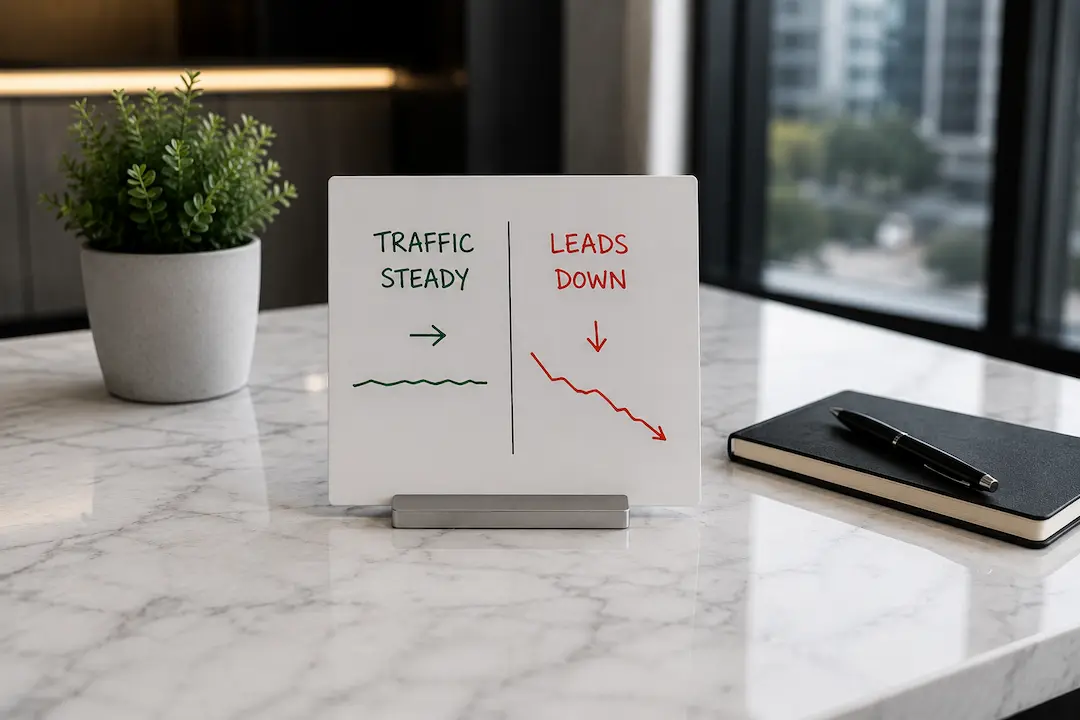
When your traffic holds but your leads fall, that is exactly what has happened.
The reassuring flat line on your traffic chart is the problem, not the comfort. It tells you the same number of visits arrived, but it says nothing about whether those visits were ready to buy, just browsing, or landing by accident.
AI search has quietly changed that composition, and the composition is what converts. A steady total made of the wrong people is worth less than a smaller total made of the right ones, yet the chart treats them as identical.
So the useful question is not how many people came, but who came and in what state of mind. Answering it means looking past the traffic total to the funnel underneath, which is where answer engine optimisation does its work.
This is why the problem is so easy to miss for so long. Traffic is the metric most dashboards lead with, and a flat traffic line reads as stability, so the alarm never sounds. Meanwhile the leads report, which lives on a different screen and often a different team, quietly declines.
Weeks pass before anyone connects the two, and by then the instinct is to blame the sales team, the season or the market, rather than the one thing that actually changed, which is the kind of person search is now sending you.
What actually changed: the mix, not the volume
The purchase journey was never a tidy line, and AI has made it messier. Google's research describes a messy middle of exploration and evaluation that buyers loop through before deciding, and much of that looping now happens inside an AI answer rather than on your site.
The result is a shift in where people are when they reach you. The classic purchase funnel ran from awareness to consideration to decision, with your content catching people at each stage.
AI now handles the early and middle stages off-site, so the awareness and consideration traffic that used to flow into your funnel as future leads is answered before it ever arrives.
Your total may hold because other, lower-intent visits fill the gap, curiosity clicks, very early researchers, people who will never buy. Same volume, weaker mix.
Harvard Business Review notes that AI is changing how customers choose businesses, and part of that change is that the high-intent research which once landed on you now happens elsewhere.
How AI reshaped each stage of your funnel
Walk the funnel top to bottom and the change becomes concrete. Each stage lost something different to the AI answer.
At the top, awareness questions are answered in place. The person learning about your category from an AI overview or chatbot never becomes the top-of-funnel visitor you would later nurture, so your future pipeline quietly shrinks months before you feel it.
At the middle, the comparison and evaluation that defined the messy middle now happen inside the AI, which weighs options and often names a shortlist, so buyers arrive already leaning towards whoever the model surfaced.
At the bottom, the ready-to-act searchers are the most valuable and the most easily intercepted. If AI recommended a competitor during the research, the decision-stage visit you expected simply goes to them instead.
The funnel did not shrink evenly, it lost its most convertible layers, which is why leads fall while raw traffic holds.
Picture the old funnel as a wide mouth narrowing to a point, with visitors entering at every level. AI has effectively reached in and skimmed the richest bands, the aware researcher and the active comparer, leaving the very top of idle curiosity and whatever accidental traffic still lands.
The shape you are left with looks full at a glance but converts like something much thinner, because the layers that used to become customers are the ones now being served their answer somewhere else.
Understanding which layers you lost is the first step to rebuilding them.
The new visitor who reaches you
The person who does arrive is not the person your funnel was built for. They come later, having already researched through AI, and they expect something different from your site.
Nielsen Norman Group's study of information foraging with generative AI shows how people now gather and pre-digest information through AI before visiting a site, arriving with answers already in hand.
That changes what they need from you: not a basic explainer they have already read from the AI, but proof, specifics, and a reason to choose you over the option the model mentioned.
These visitors also behave differently by source. Similarweb's analysis of AI referral traffic across industries shows AI-referred visitors arriving with different intent and engagement than classic search traffic, so a funnel tuned for the old visitor mishandles the new one. The mismatch, not the volume, is draining your leads.
It helps to think of them as a warmer but more sceptical guest. They arrive knowing more, so they are closer to a decision, which is good. But they also arrive having just been given a tidy, confident answer by an AI, which sets a high bar, so a vague or generic page underwhelms them fast.
They want to see that you are the specific, credible choice the AI hinted at, and they want it quickly. Win that moment and they convert well, because the hard work of consideration is already done. Miss it and they leave without a trace, because they had alternatives fresh in mind.
Why your old lead-capture stopped working
Most lead-capture was built for an uninformed browser, and that person is disappearing. The gated beginner guide, the "learn the basics" download, the slow nurture that assumed the visitor knew little, all of it targets a stage AI now owns.
When a visitor arrives already informed, offering them the introduction they have outgrown feels redundant, and they bounce.
The friction that a curious early browser tolerated, a long form for a basic resource, now costs you the more decisive visitor who wanted a straight answer or a fast next step. Your conversion tools are calibrated for a funnel stage that has moved.
This is why leads can fall even as your pages, offers and forms sit unchanged. Nothing on your side broke.
The audience arriving at those pages changed underneath them, and the offers that fit the old audience no longer fit the new one, a shift our look at how AI memory reshapes marketing explores in more depth.
There is a second, subtler cost. An informed buyer who meets a beginner offer does not just fail to convert, they quietly downgrade their impression of you.
Being served the obvious when you clearly know more signals that a brand has not kept up, which is precisely the wrong signal to send someone comparing you against an option an AI just praised.
So the outdated funnel does double damage: it misses the conversion and it dents the credibility, at the exact moment credibility decides the sale.
How to rebuild the funnel for AI search
The fix is to rebuild the funnel around the new reality: be present in the AI research, and convert the informed visitor who arrives. The two must go together, because being cited without a converting page wastes the visit, and a great page nobody is sent to wastes the effort. Here is the playbook.
Get into the research, not just the destination
If the research happens inside AI, you need to be in it. Structure your content to be the source AI cites during exploration and evaluation, so your brand shapes the shortlist rather than missing it. Being named while someone decides is the new top of funnel, and it is the heart of becoming a cited source.
Spread that presence across ChatGPT search and Perplexity so you appear wherever the research runs.
Give Google's AI answers the same attention, since a modern buyer rarely researches on a single platform and you want to shape the shortlist on all of them.
Rebuild conversion for the informed buyer
Meet the visitor at the stage they actually arrive. Replace beginner explainers with proof, specifics, comparisons and clear reasons to choose you, and shorten the path from arrival to enquiry.
Give the decisive visitor a fast, low friction next step rather than a slow nurture they have already outgrown, and make your money pages answer the exact questions a researched buyer asks before committing.
This rebuild sits alongside recovering lost traffic through AEO, because getting cited and converting the click are two halves of the same job.
Capture and qualify the intent that remains
Fewer but warmer visitors means qualification matters more than volume. Use clear calls to action, and offers that suit a late-stage buyer such as a quote, an audit or a consultation rather than a basic guide.
A smaller stream of well-qualified enquiries can out-earn the old flood, and it aligns your effort with measuring AEO return by conversion rather than clicks.
Rethink your success metric while you are at it. If you keep judging performance by sessions, an AI-reshaped funnel will always look like a failure, because the volume game is the one AI has changed most.
Judge it instead by qualified enquiries, conversion rate and revenue per visit, and a leaner, better-converting funnel starts to read as the win it actually is.
The businesses that adapt fastest are usually the ones that let go of traffic as the headline number and put conversion of the right visitor in its place.
How to confirm this is your problem
Before you rebuild, confirm the diagnosis. The signature is distinctive: traffic roughly flat, leads or enquiries down, and conversion rate falling even though your pages have not changed.
Check whether your conversion rate dropped while traffic held, because that points to a change in visitor quality rather than in your site. Segment by source and look at how AI-referred and organic visitors convert compared with before.
DataReportal's figures on the scale of AI-shaped search behaviour explain why this pattern is now so common, and seeing it in your own numbers confirms the funnel, not the traffic, is where to act.
Add one more read: the questions your enquiries now ask. When leads do come through, notice whether they arrive further along, asking about price, timelines or specifics rather than the basics they once did.
That shift in the questions is a fingerprint of the reshaped funnel, because it shows the early education now happens before people reach you.
If your remaining enquiries are more advanced but fewer, you are not imagining the change, you are watching the new funnel work exactly as this article describes.
Start from your home base and let a structured AI visibility audit map where you sit in the AI research and where your conversion leaks.
Tie the fixes back to your generative engine optimisation plan, and pair them with the trust work in how AEO builds brand trust so an informed buyer has every reason to choose you over the option the model mentioned.
Our case study shows how rebuilding the funnel, not chasing traffic, is what restores the leads, because the fix has to match where the loss actually happened.


.svg)
.svg)
.svg)
.svg)
.svg)



.svg)

.svg)


.svg)
.svg)
.svg)

.svg)
.svg)