Why your rank can hold while your traffic falls
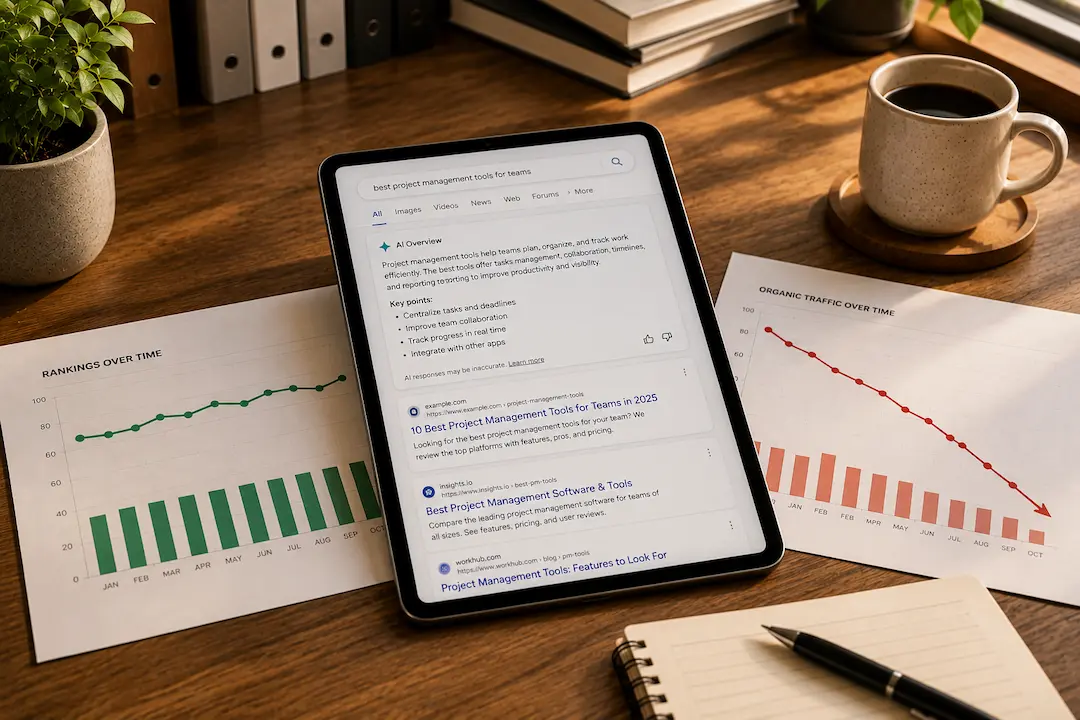
For twenty years, a stable ranking meant stable traffic. Position one earned roughly the same share of clicks month after month, so if your rank held, your visits held. That link has broken, and the rank tracker that once told you everything now hides the problem.
The reason is that the results page above your listing has changed. An AI Overview, a featured answer, or another rich feature now often sits between the searcher and the first blue link.
Your position is unchanged, but the real estate above it has grown, and much of the attention and the clicks are absorbed before anyone reaches you.
So the metric to trust has shifted from rank to clicks. A healthy position on a page topped by an answer box is worth a fraction of what it was, even though your tracker reports no change. Reading this correctly is the first step, and it reframes the whole problem as one for answer engine optimisation rather than classic ranking work.
This is why so many teams misdiagnose the situation for months. Their reporting is built around rank, so every dashboard reassures them that nothing is wrong, while the business quietly feels the drop in enquiries. They look everywhere except the one place the answer sits, which is the space above their listing. The tracker is not lying, it is simply measuring the wrong thing for a results page that no longer works the way it did when the metric was designed.
What the AI Overview squeeze actually is
The squeeze is simple to picture. Google increasingly answers the query itself, in an overview at the top of the page, drawing on several sources. The searcher reads the answer and often stops there, satisfied, without scrolling to the results you rank in.
Your listing has not moved. It is still there, still at the position your tracker shows. But it now sits below a block designed to make the click unnecessary, so a page that once earned the click by ranking well now has to earn it past an answer that already served the searcher.
This is why the symptom is so confusing. Every tool that measures position says you are fine, while every tool that measures visits says you are not. Both are correct. The gap between them is the squeeze, and closing it means changing what you optimise for, which is the core of turning lost traffic into AI citations.
It helps to understand the shift as a change in the currency of search. Rank used to be the currency because rank bought clicks reliably. Now the currency is the citation, the mention inside the answer, because that is what puts you in front of the searcher when the click may never come.
If you are new to the idea, the fundamentals of what answer engine optimisation is explain why being in the answer now matters more than sitting just below it.
The data: same position, fewer clicks
This is measurable, and the numbers are stark. Sistrix's analysis of click behaviour concludes that almost everything we knew about Google CTR is no longer valid, because the click-through rate a given position earns has fallen as the results page filled with features and answers.
The effect is sharpest exactly where it hurts most. Coverage of one study found that AI Overviews cut the top organic click-through rate by well over half where they appeared, so even a number one ranking can shed most of its clicks the moment an overview sits above it. The better your position, the more you had to lose.
Baseline click curves make the scale clear. Reference data such as the organic click-through rates by position show how much traffic each spot historically earned, and how far below those benchmarks a feature-heavy results page now pulls real performance.
When you compare your own click-through against what a position used to deliver, the missing clicks are the squeeze made visible.
The important point in all this data is not the exact percentage, which varies by market and query, but the direction and the consistency. Study after study, using different methods and different samples, reaches the same conclusion: the click a given position earns has fallen, and it falls furthest where an answer appears above it.
That agreement matters, because it means the squeeze is not a quirk of your site or a temporary blip. It is a structural change in how search works, and structural changes reward the businesses that adjust their strategy rather than wait for the old numbers to return.
How to confirm it is the squeeze, not a ranking drop
Before you act, prove the diagnosis, because the fix for a squeeze is nothing like the fix for a genuine ranking loss. The confirmation lives in your Search Console data.
Google's guidance on analysing search traffic drops points to the pattern to look for. If your impressions and average position are stable but your clicks have fallen, you have not lost ranking, you have lost click-through, which is the squeeze. If impressions and position fell too, that is a different, more traditional problem.
Then narrow it to the query level. Filter to the queries and pages that lost clicks, and check each one in a live search to see whether an AI Overview or answer feature now sits above your result. Where it does, you have confirmed the cause.
Pairing this read with your AEO measurement turns a confusing chart into a precise, query-by-query picture of where you are being squeezed.
Do the live check yourself rather than trusting a report, because overviews appear and disappear by query, location and even the phrasing of the search.
Run the exact terms your affected pages target, in the way a real customer would type them, and note which trigger an answer above you and which do not. That short manual pass often reveals the pattern faster than any tool, and it grounds the rest of your plan in what searchers actually see.
Which of your pages the squeeze hits hardest
The damage is not spread evenly, and knowing the pattern tells you where to act first. Informational and question-shaped queries are the most heavily affected, because those are exactly what overviews answer best.
Semrush's analysis of AI Overviews across a large set of keywords shows how widespread these answer features have become and which query types trigger them most, and it is the how-to guides, definitions and explainers that sit squarely in the firing line.
Your commercial and transactional pages tend to hold up better for now, because overviews appear on them far less often.
That split is your priority map. The pages losing the most are usually your top-of-funnel content, which then feeds your money pages, so the squeeze on informational traffic shows up later as fewer leads.
Protecting the pages that still earn clicks and re-engineering the ones being answered above is where the effort belongs, and it maps neatly onto how you optimise for AI Overviews and snippets.
What this looks like in practice
The story repeats across businesses that felt this without understanding it. The rank tracker stayed green, the monthly report looked stable, and yet enquiries thinned out with no obvious cause. The team spent weeks trying to climb positions they already held, and nothing moved, because position was never the problem.
The turnaround came from reading the right numbers. Once they compared impressions against clicks and checked the affected queries live, the overviews sitting above their best pages were obvious.
They stopped chasing rank, rebuilt those pages to be cited in the answer, and redirected effort towards the transactional queries that still earned clicks. The traffic total stayed lower than its old peak, but the clicks that came were warmer and the leads recovered.
Our case study shows the same shift in full: progress came from changing what was measured and optimised, not from forcing a ranking that was already fine. The lesson is consistent, that in AI search you win by being in the answer, not just near it.
What to do about it
You cannot un-invent the overview, so the strategy is to work with it. That means being inside the answer, winning the searches it does not touch, and converting the clicks that remain. Here is the playbook.
Become the source the overview cites
If the answer is going to appear, be the source it is built from. Structure your content to answer the exact question directly and early, add schema, and bring expertise the model cannot fabricate, so you are named in the overview rather than buried beneath it.
A citation keeps you visible and trusted even when the click is scarce, which is what becoming a cited source is all about.
Win the queries that still get clicks
Not every search triggers an overview. Transactional, local and highly specific queries often stay click-rich, so shift effort towards the searches where a click is still on offer. Build genuinely useful, specific pages for those intents, and make sure you rank and convert there.
Spreading visibility across ChatGPT search and Perplexity widens the set of surfaces where you can still be found.
Capture and convert the clicks that remain
The searchers who click past an overview are further along and more valuable. Meet them with sharp calls to action, a low friction path to enquire, and pages that convert, since a smaller, warmer stream can out-earn the old volume. Extending that presence to Google's AI answers keeps you in front of the intent even as the results page changes.
There is a mindset shift buried in this playbook that is worth naming. For years the goal was more traffic, and volume covered a multitude of conversion sins. In a squeezed results page, volume is exactly what you cannot count on, so the emphasis moves to quality and conversion of every visit you still earn.
A business that gets more from fewer clicks is far more resilient to the next change in the results page than one that simply chased bigger numbers. Treat the squeeze as a prompt to build that resilience now, while you still have time to do it calmly rather than in a panic.
Why chasing rankings harder will not fix it
The natural reflex is to push for a higher ranking, but that misreads the problem. You are not losing because your position slipped. You are losing because the position itself is worth less on a page topped by an answer.
The stakes are real. Independent reporting describes AI search as an existential shift for publishers precisely because ranking well no longer guarantees the traffic it once did.
Doubling down on the old game, more links and more on-page tweaks to climb a spot you already hold, spends effort on a lever that no longer moves the outcome.
The businesses that adapt will stop measuring success by rank alone and start measuring it by citations and clicks. Start from your home base, confirm the squeeze in your own data, and shift the work towards being cited and winning clickable intent.
A structured AI visibility audit shows exactly where the squeeze is landing and which pages to defend first. Pairing it with an AI SEO plan keeps you visible as the results page keeps evolving, so the effort compounds instead of chasing a ranking number that no longer maps to revenue.


.svg)
.svg)
.svg)
.svg)
.svg)



.svg)

.svg)


.svg)
.svg)
.svg)
.svg)
.svg)