Why telling them apart matters
The two causes feel identical at first. Traffic falls, leads thin out, and the pressure to do something builds. But acting before you know the cause is how businesses waste a month, because the fixes point in opposite directions.
Solve a core update as though it were a squeeze, by chasing AI citations, and your rankings stay down because the real issue was content quality. Solve a squeeze as though it were a core update, by rewriting good pages for quality, and nothing improves because your rankings were never the problem. Same symptom, opposite cure, and only a correct diagnosis tells you which to reach for.
That is why this is worth an afternoon of careful reading before a month of work. Getting it right turns a guess into a plan, and it anchors whatever comes next in your broader answer engine optimisation strategy rather than in panic.
The cost of guessing is not just the wasted month either. While you work the wrong fix, the real cause keeps draining traffic and leads, so the true bill is the wasted effort plus everything the untreated problem cost in the meantime. That compounding is what makes a careful diagnosis such a bargain: a few hours of reading protects both the work you are about to do and the revenue you would otherwise keep losing while you did it.
What each one actually is
Start with clear definitions, because the fixes hang off them. The two are different kinds of event entirely.
A Google core update is a broad change to how Google assesses and ranks content. Google's own guidance on core updates describes them as significant, site-wide reassessments of relevance and quality, so a drop from one means Google now rates your content lower relative to others. Your rankings genuinely move.
An AI Overview squeeze is not a ranking change at all. An AI Overview is Google's AI-generated answer at the very top of the results, and a squeeze happens when it sits above your listing and satisfies the searcher before they click, even though your position has not moved. Academic research on the impact of AI search summaries on website traffic documents how these answers reduce click-through to the sources beneath them, which is the squeeze in a sentence: same rank, fewer clicks.
The tell-tale differences at a glance
Before the step-by-step, here is the quick contrast. Most drops match one column cleanly once you look.
| Signal |
AI Overview squeeze |
Core update |
| Average position |
Stable |
Falls |
| Impressions |
Stable or rising |
Falls |
| Clicks |
Fall |
Fall |
| What is hit |
Informational, question queries |
Broad, across content types |
| Timing |
Lines up with an overview appearing |
Lines up with a confirmed update |
| Live results |
An answer sits above you |
You rank lower or off page one |
| The fix |
Get cited, win clickable queries |
Improve content quality and E-E-A-T |
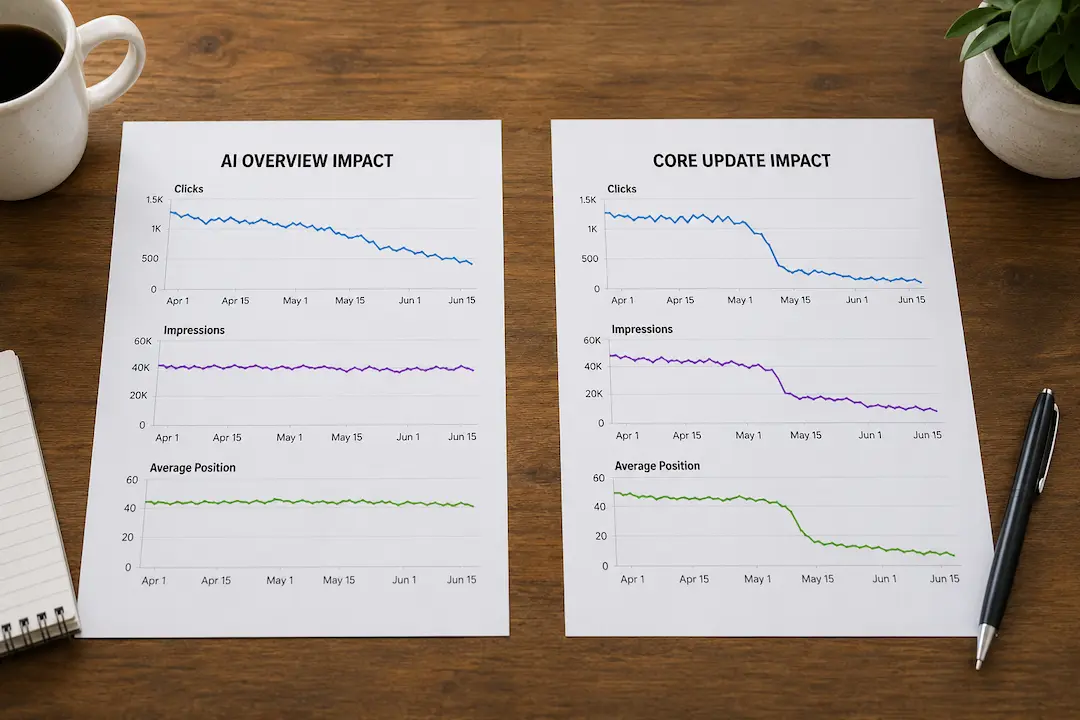
The single most useful line in that table is average position. If it held while clicks fell, you are looking at a squeeze. If it dropped, you are looking at a ranking event such as a core update. Everything else in the table confirms or refines that first read, but position is where you should always start.
Signal one: the Search Console signature
Your Search Console data settles most cases on its own. Put clicks, impressions and average position on the same chart for the drop period and read them together.
A squeeze shows stable impressions and stable average position while clicks fall, because you are still shown as often, at the same rank, but the click is intercepted above you. A core update shows impressions and average position falling alongside clicks, because you are being shown less and ranking lower. The difference is unmistakable once you look at all three lines rather than clicks alone, and it pairs naturally with your AEO measurement.
This one signal resolves the majority of drops. If it is ambiguous, the remaining signals break the tie, but most of the time the position line has already told you the answer.
There is a subtle version worth watching for. If your average position improved slightly while clicks still fell, that is an even stronger squeeze signal, because you got closer to the top and still lost the click, which only an answer above you explains. Conversely, a small position drop with a large click drop can be a mix of both causes, and that is your cue to weigh the remaining signals carefully rather than settling on one verdict too soon.
Signal two: the timing
Dates are decisive, so line your drop up against the calendar. Both causes are tied to events, and those events are on record.
For core updates, Google publishes confirmed dates. The Search Status Dashboard lists when ranking updates rolled out, so if your drop begins the day a core update started, that is powerful evidence. Sistrix analysis of a recent core update's volatility shows how these events shake many sites at once, so a drop shared across your whole sector on an update date is a core-update signature.
An AI Overview squeeze has different timing. It tends to begin when overviews start appearing for your queries, which may not align with any confirmed update at all. A drop that starts on no known algorithm date, but coincides with answers appearing above your searches, points to the squeeze rather than an update. Overviews also expand gradually across query types, so a squeeze can arrive as a series of smaller steps rather than a single dated event, which is another way it differs from the sharp, dated movement of a core update.
Signal three: what got hit
The scope of the damage is a strong clue, because the two causes hit different things. Map which pages and queries lost traffic and the pattern usually declares itself.
A core update tends to affect content broadly, across page types and topics, because it is a reassessment of quality and relevance rather than a feature above one kind of query. If your losses are spread across commercial, informational and everything between, that breadth suggests an update.
A squeeze is narrower and more predictable. It concentrates on informational, question-shaped queries, the definitions and how-to searches that overviews answer best, while transactional and branded queries hold up. If your losses cluster there and your money pages are steady, that concentration points to the squeeze, which our guide to optimising for AI Overviews then helps you act on.
A quick way to test this is to sort your lost clicks by query and read the top of the list. If it is dominated by what, how and why questions, the squeeze is the likely culprit. If it is a jumble of commercial, comparison and informational terms with no obvious theme, a broad reassessment such as a core update fits better. The shape of the loss, not just its size, is doing the diagnostic work here.
Signal four: the live results
Finish with your own eyes. Take the queries that lost the most clicks and run them in a real search, the way a customer would.
If an AI Overview or answer feature now sits above your listing while your result is still there at its usual spot, that is a confirmed squeeze. If your page has slipped down the results or off the first page entirely, that is a ranking event consistent with a core update. Checking across ChatGPT search and Perplexity also shows whether the same questions are being answered away from Google. The live view is the tie-breaker when the data is close.
If it is a core update: what to do
A core update is not a penalty, so there is no switch to flip. Google is clear that recovery comes from improving your content overall, not from a quick technical fix.
Focus on quality, expertise and genuine helpfulness across the affected pages, and strengthen the experience and trust signals that Google leans on. Search Engine Land's core update recovery guidance walks through the practical steps, and our own work on E-E-A-T for AEO shows how the same signals that recover rankings also earn AI citations. Then be patient, because rankings from a core update typically recover over time as Google reassesses, often around the next update.
Resist the urge to make sweeping, panicked changes. Core updates reward genuine improvement, not frantic activity, so gutting pages that were merely caught in a broad reassessment can do more harm than good. The better approach is to identify your weakest, thinnest content, improve or consolidate it, and lift the overall quality of the site rather than chasing a single ranking. The businesses that recover best treat a core update as a prompt to become genuinely more useful, which is a durable win regardless of what the next update brings.
If it is the squeeze: what to do
A squeeze needs the opposite response. Your content is already good enough to rank, so the work is to get into the answer and to win the clicks that remain, not to rewrite pages that were never the problem.
Aim to be the source the overview cites, structure your best pages to answer the question directly, and shift effort towards the transactional and local queries that still earn clicks. Recovering that ground is exactly what turning lost traffic into AI citations is built around, and extending your presence to Google's AI answers keeps you visible as the results page changes.
The trap here is rewriting good pages out of frustration. Because a squeeze feels like your content failed, the instinct is to overhaul it, but the content is fine, the results page changed around it. Redoing pages that already rank well wastes effort and can even weaken what was working. Direct that energy instead at prominence in the answer and at converting the clicks that remain, and the same content starts earning its keep again.
When it is both, and how to prioritise
Sometimes the honest answer is both, a core update softened your rankings while overviews took clicks from what remained. The signals will look mixed, with position down somewhat and overviews visible above you.
When that happens, sequence the work rather than splitting it. Fix the content-quality problem first, because a squeeze on a page that no longer ranks is a smaller worry than the ranking loss itself, then layer the citation and click-capture work on top. Reference the definition of the challenge in what answer engine optimisation is so the two efforts pull in the same direction rather than competing for attention.
Whichever it is, start from the evidence. Begin at your home base, run the four signals, and let a structured AI visibility audit confirm the cause and the order of the fixes.
Tie the plan back to your AI SEO roadmap so the fix holds as search keeps shifting, rather than becoming a one-off scramble that ages out at the next change.
Our case study shows how a correct diagnosis, not a rushed one, is what actually recovers traffic, because effort spent on the real cause is the only effort that pays back.


.svg)
.svg)
.svg)
.svg)
.svg)



.svg)

.svg)


.svg)
.svg)
.svg)
.svg)
.svg)