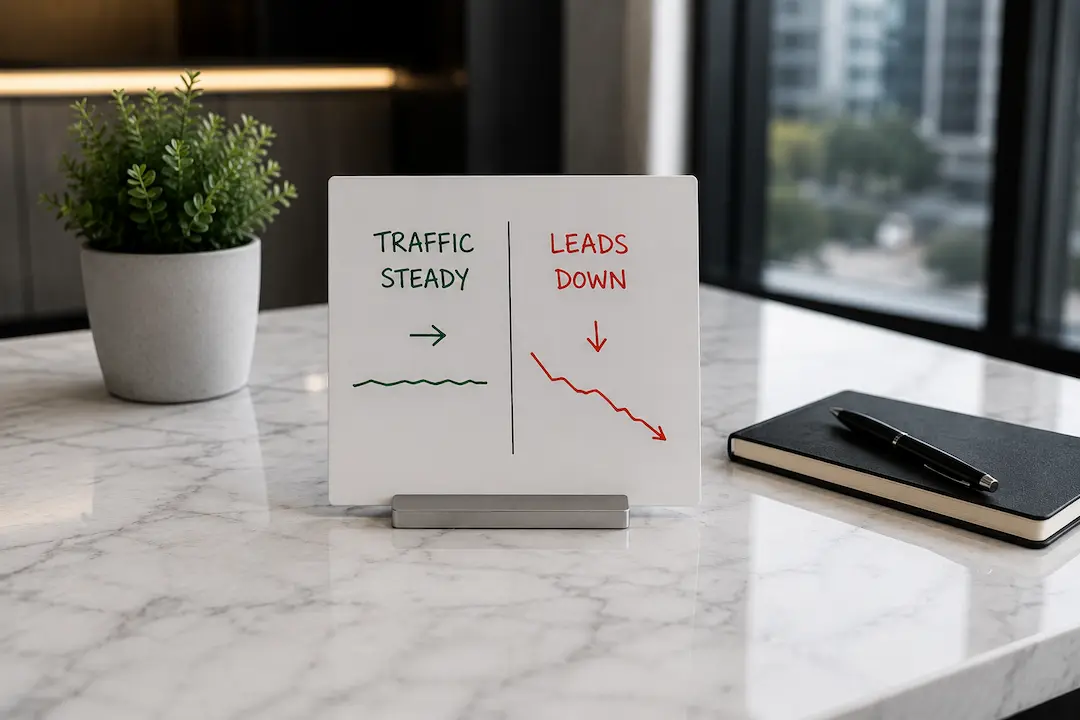
Why your money pages are at risk even when they look safe
Right now your service and product pages probably look fine. The traffic loss is showing up on blog posts, guides and explainers, not the pages that take the enquiry or the sale. That reading is comforting, and it is dangerous.
Money pages rarely earn traffic on their own. People do not usually search a transactional query cold. They research first, land on your helpful content, learn to trust you, then move to the page that converts.
When AI Overviews absorb that research step, the top of your funnel quietly narrows, and the money pages starve a few weeks later.
So the threat is indirect but real. The pages being eaten today are the ones that used to hand visitors to the pages you care about most.
Protecting revenue means protecting the whole path, not just the final step, which is why this sits at the heart of answer engine optimisation.
It helps to picture the funnel as a set of connected pipes rather than separate pages. Water still flows into the bottom tank today, so the tank looks full. What you cannot see from the tank is that the pipe feeding it has narrowed.
By the time the level drops, months of inflow have already been lost, and the fix takes far longer than noticing the narrowing would have. Money pages are that bottom tank, and informational content is the pipe.
Which pages AI is actually eating right now
The pattern is clear once you look at query intent. Informational searches trigger overviews far more often than commercial ones, and the gap is large.
Analysis of AI Overviews across commercial search shows overviews appearing far more often on informational questions such as "what is" and "how does" than on transactional, buy-ready queries, which still trigger them on a much smaller share of searches.
The pages summarised first are your guides and explainers, not your quote and product pages, though the study also finds commercial coverage steadily expanding.
There is a reason for the split. Holding overviews back on transactional queries keeps space for paid results and shopping ads, so Google has a commercial incentive to leave buy-ready searches largely alone for now.
That is good news for your money pages in the short term, and a warning about where the pressure lands instead, which is squarely on the content that feeds them.
Map your own pages against this hierarchy and the risk becomes concrete. Your definitional guides, how-to articles and beginner explainers sit in the high-coverage zone and are almost certainly losing clicks already.
Your quotes, pricing, comparison and enquiry pages sit in the protected zone for now. The moment you can see which of your pages fall where, you know exactly which feeders to defend and which money pages they support.
Why "my money pages are fine" is a dangerous read
The comfort is real but temporary, and it rests on two blind spots. Both matter for revenue.
The first is the funnel dependency already described. If your informational pages lose half their clicks, the audience that would have discovered you, joined your list and later converted simply never arrives.
Nielsen Norman Group research on how AI is changing search behaviour shows users increasingly get their answer inside the AI layer and self-serve, which means fewer of them ever reach a website to begin a relationship.
The second is drift. Commercial overview coverage is low today, but it is not fixed. As the systems mature and advertisers adapt, more commercial and comparison queries are gaining overviews over time.
Planning as though your money pages will stay untouched forever is a bet against the clear direction of travel, and the businesses that prepare early will absorb the change far more comfortably than those caught flat.
What the drift towards commercial coverage means for you
Industry coverage of the shift is blunt about the direction. Forbes describes how AI Overviews are already eating website traffic and urges businesses to adapt rather than wait, because the pages losing clicks today are the early warning for the ones that lose them tomorrow.
For your money pages, the practical takeaway is timing. You have a window while commercial overview coverage stays low, and that window is exactly when protection is cheap.
Building citation authority, tightening conversions and diversifying demand while your revenue pages are still safe is far easier than scrambling once overviews start appearing on your comparison and buying queries.
Treat the current calm on commercial searches as preparation time, not proof of permanent safety.
The businesses that move in this window turn a looming threat into a moat. They reach the moment commercial overviews expand already cited, already converting and already less dependent on any single click, while slower competitors are only then discovering the problem.
Preparation bought early is almost always cheaper than recovery bought late.
How to protect your money pages
Protection is not one move, it is a layered defence. You shore up the feeder content, harden the money pages themselves, build demand that does not depend on a click, and capture what traffic remains. Here is the playbook.
Shore up the informational layer that feeds them
Do not abandon informational content, change its job. Rebuild your best guides and explainers to be the source an overview cites, not just a page it summarises. Lead each section with a direct answer, add schema, and bring genuine expertise the model cannot manufacture.
A cited brand still gets seen, remembered and, often, visited. The step to becoming a cited source is what keeps your name in front of researchers even when the click disappears.
Prioritise depth over volume here. One genuinely authoritative guide that answers a question better than anyone else is more likely to be cited than ten thin posts that merely restate the obvious.
Consolidate overlapping articles, add original insight, examples and data the model cannot find elsewhere, and make each feeder page unmistakably the best answer to its question. That is the content most likely to survive the overview and keep pointing people towards your money pages.
Strengthen the money pages themselves
If fewer people reach your service and product pages, each visit has to work harder. This is where conversion craft pays off. Baymard Institute research on product and money-page UX shows most pages leak conversions through unclear value, weak trust signals and friction at the decision point.
Tighten your headlines, proof, pricing clarity and calls to action so a smaller, warmer stream of visitors converts at a higher rate.
Money pages also deserve their own AEO treatment. Add clear answers to the exact questions buyers ask before committing, mark them up, and make the page easy for both people and models to understand.
Our guidance on GEO for ecommerce and commercial pages covers how to make transactional pages legible to AI without diluting their selling job.
The two jobs reinforce each other. A money page that answers real buyer questions clearly is both more persuasive to a human and more legible to a model, so the same work that lifts conversion also improves your odds of being surfaced when commercial overviews do expand.
Think of every objection you address, every proof point you add and every price you make transparent as doing double duty: converting the visitor in front of you today, and earning the citation that brings the next one tomorrow.
Build demand that does not depend on a single click
The most durable protection is being the brand AI recommends.
Similarweb found that being present in AI answers drives meaningfully more downstream site visits, around two and a half times more in their analysis, because a recommendation carries intent a passive listing never did. When the model names you, the visitor arrives already leaning towards you.
This is a new channel, not a rounding error. AI referrals to top sites rose sharply year on year, and the businesses building citation authority now are the ones capturing it.
A visitor who arrives on a money page because an assistant recommended you is worlds apart from one who stumbled in cold, and they tend to convert accordingly.
Spread your visibility across ChatGPT search and Perplexity as well as Google's Gemini-powered answers, so no single algorithm change can cut off your demand. Diversified presence across the assistants is insurance: when one shifts its sourcing, the others keep sending qualified visitors to the pages that earn revenue.
Capture the click that remains and diversify entry points
Some searchers still click, and the ones who do are further along. Make those visits count with sharp calls to action, a low friction enquiry or quote path, and a reason to share an email such as a template or audit.
At the same time, reduce dependence on any one entry point by nurturing direct, email and referral demand, so a change to one channel never threatens the whole pipeline. Recovering discovery lost to the overview is exactly what bringing traffic back with AEO is about.
How to measure whether your money pages are protected
You cannot protect what you do not watch, so measure the feeder and the destination together. Looking at money pages alone hides the upstream leak until it is too late.
Track your informational pages for the tell-tale pattern of steady impressions but falling clicks, which signals a page being read inside an overview.
Then follow the chain: are assisted conversions, list sign-ups and enquiries from content holding up, or thinning out? Watch your AEO return on investment across the funnel, not page by page in isolation.
Add a citation check to the routine. Run the questions your buyers ask across the major assistants and note whether you are named, because citation share is becoming as important as ranking. Optimising for Google's AI answers and tracking where you appear turns a vague worry into a specific, fixable list.
Turning the threat into an advantage
The squeeze is uncomfortable, but it is also a filter. Most competitors will either panic and stop publishing, or ignore the shift until their money pages feel it. Neither response builds anything.
The businesses that win will treat this as a chance to consolidate. They will publish fewer, deeper, citation-worthy pieces, make their money pages genuinely excellent, and become the name AI reaches for in their category.
That combination compounds, because being cited earns familiarity, familiarity earns visits, and strong money pages turn those visits into revenue.
Building that brand trust in the AI era is what separates the protected from the exposed.
There is a quieter benefit too. When you stop chasing raw traffic and start engineering the whole path from first answer to final conversion, your marketing gets simpler and more measurable.
You publish less but better, you know which pages feed revenue, and you can see when a feeder weakens before it hurts the tank below.
That clarity is worth as much as the traffic itself, because it lets you spend limited effort exactly where it protects the most revenue.
Start from your home base, map which feeder pages are slipping, and prioritise the fixes that protect revenue first. A structured AI visibility audit will show you exactly where the pressure is landing and which money pages to defend.
Pairing that with an AI SEO plan keeps the whole funnel working as search keeps changing, so protection becomes an ongoing habit rather than a one-off scramble.
The goal is a system that adapts each month, not a single fix that ages out the moment the overview coverage shifts again.


.svg)
.svg)
.svg)
.svg)
.svg)




.svg)

.svg)


.svg)
.svg)
.svg)

.svg)
.svg)