Why lead recovery is different from traffic recovery
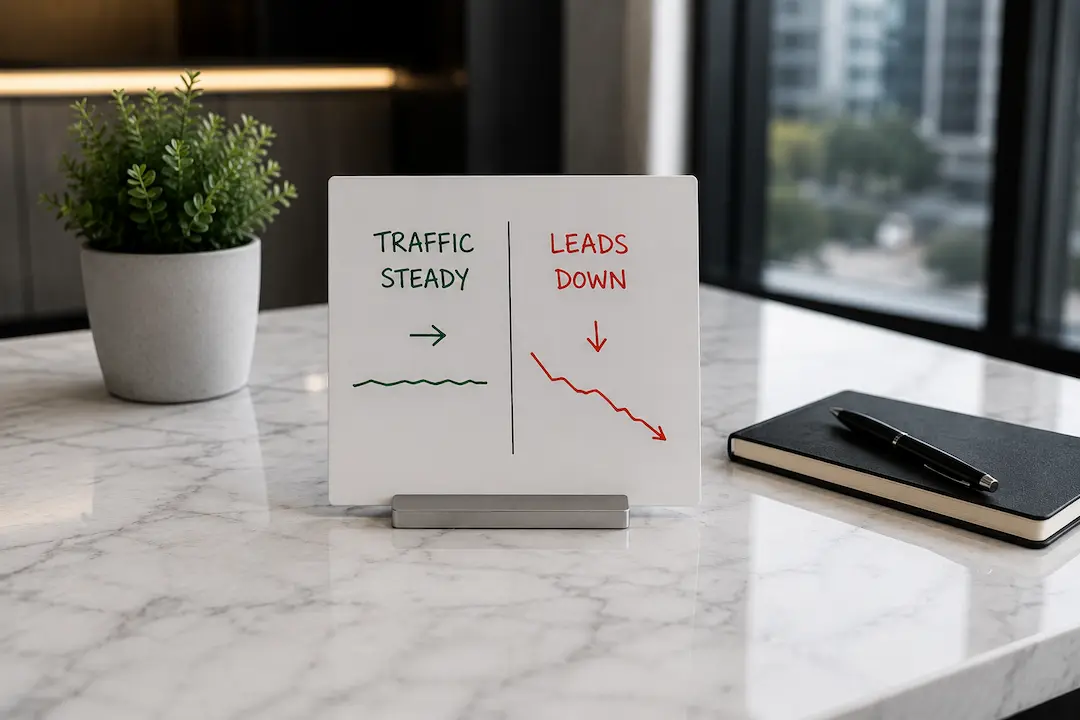
Most advice about AI search fixates on traffic, because traffic is easy to chart and alarming to watch fall. But traffic is a means, not an end. You can win back sessions and still see no more enquiries, because the sessions you recover may not be the ones that ever converted.
Lead recovery starts from the other end. Instead of asking how to get the visits back, it asks how to get the enquiries back, which points you at different work: the specific high-intent moments AI intercepted, and the conversion of whatever visits still arrive. Those two levers move leads even when traffic stays flat.
This reframing matters because it changes what counts as success. A traffic mindset celebrates a rebound in sessions and quietly ignores whether any of them became customers. A lead mindset ignores the sessions and asks only whether enquiries are climbing.
The two can point you at completely different tasks on any given week, and in a world where AI answers the low-value questions for free, the lead mindset is the one that keeps your effort tied to money rather than to a number that no longer predicts it.
So the plan below is deliberately not a traffic plan. It is a lead plan, aimed squarely at enquiries and built on answer engine optimisation rather than raw volume. Each step is chosen because it recovers leads, not because it looks good on a sessions graph.
It helps to hold the distinction firmly, because the two goals can quietly pull in different directions. Chasing traffic can tempt you into broad, low-intent content that lifts sessions while doing nothing for enquiries.
Chasing leads keeps you focused on the narrow, high-value moments where buyers decide.
If you have ever grown your traffic and watched your enquiries stay flat, you have felt the gap between the two, and the fundamentals of what answer engine optimisation is explain why closing it means optimising for the answer, not the click count.
Step one: find where the leads actually leaked
Before fixing anything, locate the leak precisely, because leads and traffic rarely fall in the same place. The site-wide total hides it, so go to the level of source and conversion.
Set up proper conversion tracking and read leads by channel. Google's guidance on measuring key events explains how to track enquiries, form submissions and calls as conversions, so you can see which sources stopped delivering them.
Compare how organic and AI-referred visitors convert now against an earlier period, and the leak usually reveals itself as a specific source or page that lost its enquiries.
This step alone often reframes the whole problem. Many businesses discover their traffic barely moved while a particular high-intent channel quietly stopped converting, which tells you exactly where to aim, and it is the foundation of measuring AEO return across the funnel.
Do not skip the boring part of this step, which is getting the tracking right in the first place. A surprising number of lead panics turn out to be a broken form event or a mis-tagged thank-you page rather than a real decline, so confirm your conversions are actually firing before you diagnose a cause.
Cross-check what your analytics reports against the enquiries that genuinely reached your inbox or phone. When those two numbers agree, you can trust the leak you have found and act on it with confidence rather than guessing.
Step two: recover the high-intent citations
Leads come from high-intent moments, and those are the moments AI answers most often intercept. Recovering the leads means recovering your presence in those specific answers, not your traffic in general.
Identify the buying-stage questions that used to bring enquiries, the comparisons, the how-much and which-is-best searches, and work to be the source AI cites when it answers them.
Search Engine Land notes that AI Overview citations often do not drive clicks the way rankings did, so the goal is to be named as the trusted option at the deciding moment, shaping the choice even when the click is scarce. Becoming that cited source for your money questions is where lead recovery really begins.
Be selective about which questions you chase. Not every query that lost visibility mattered to your leads, so focus your citation effort on the handful of buying-stage questions that historically produced enquiries.
Winning back a citation on how-to-choose or which-is-best for your service is worth more than reclaiming a dozen broad informational terms that never converted. Concentrating on the questions closest to a purchase is what makes citation work a lead-recovery lever rather than a vanity exercise.
Do this across the surfaces your buyers use. Being cited in ChatGPT search and Perplexity means you influence the decision wherever the research happens, not just on one engine.
Extend the same effort to Google's AI answers, since a buyer weighing a decision rarely consults a single tool, and a citation on every surface they check is what turns research into an enquiry with your name on it.
Step three: convert the warmer visits harder
The visitors who still arrive are fewer but warmer, having often seen you recommended, so squeezing more leads from them is the fastest recovery lever you control. This is conversion work, and it pays back quickly.
Start with your forms and enquiry paths, because that is where warm visitors are lost. Nielsen Norman Group's form usability research shows how clarity, sensible field order and removing friction lift completion, and Baymard's work on minimising form fields demonstrates how every unnecessary field costs conversions.
Cut your forms to the essentials, make the next step obvious, and remove anything that makes a ready buyer hesitate. Every field you drop and every second you shave off the path to enquire tends to show up directly as more leads from the same visits.
Then match the page to the visitor. A researched buyer needs proof, specifics and a fast path to enquire, not a beginner explainer, so rebuild your key pages to convert the informed visitor who now arrives, guided by how you optimise for AI Overviews.
The reason conversion is the fastest lever is simple arithmetic. If a page turns two in every hundred visitors into leads, lifting that to three is a fifty per cent increase in enquiries from the exact same traffic, with no new visibility required.
Warmer AI-referred visitors make that lift easier to achieve, because they arrive closer to a decision, so the ceiling on your conversion rate is often higher than it used to be.
Businesses that obsess over recovering lost visits frequently overlook this, leaving the quickest and most controllable win on the table while they chase the slowest one.
Step four: capture and qualify the intent that remains
Fewer visits make every genuine intent signal precious, so capture more of them and waste none. The aim is to turn interest into a lead before the visitor leaves, even if they are not ready to buy today.
Offer next steps that suit a late-stage buyer, such as a quote, an audit or a consultation, rather than a basic guide they have outgrown.
Give a reason to share an email, capture enquiries through more than one channel, and make it easy to start a conversation on the visitor's terms.
Search Engine Journal's guidance on adapting to AI Overviews reinforces that the businesses recovering fastest are converting and qualifying the traffic they keep, not mourning the traffic they lost.
Add lightweight ways to catch intent that is not quite ready to enquire. A visitor who is close but not committed may still take a downloadable comparison, a pricing estimate or a quick question answered by chat, and each of those is a chance to start a relationship you can nurture.
The goal is to leave no genuine signal of interest uncaptured, because with fewer visits arriving, every one that shows real intent is worth far more than it was when traffic was plentiful. A single well-qualified enquiry now can outweigh a dozen idle visits.
Step five: build lead paths that do not need the click
The most durable recovery adds lead sources that do not depend on a search click at all. If AI can intercept the click, you want enquiries arriving by routes it cannot touch.
Lean on the brand familiarity that citations build, and turn it into direct and referral demand: an email list you own, a reason for happy clients to refer you, and a brand people remember and search for by name.
These paths are slower to build but far harder to disrupt, and they mean a change to one answer engine never empties your pipeline.
Recovering discovery lost to AI is what bringing traffic back with AEO is about, and the lead paths you build alongside it are what make the recovery stick.
Think of these owned channels as insurance against the next shift. Search behaviour has changed twice over in just a few years, and it will change again, so a pipeline that depends entirely on how one platform answers questions is fragile by design.
An email list, a referral habit and genuine name recognition keep producing enquiries regardless of what the results page does next. The businesses least rattled by each new AI update are invariably the ones that had built demand they owned before they needed it.
Step six: measure leads back, not traffic back
Judge the recovery by the only number that matters, which is enquiries. It is easy to celebrate a traffic rebound that produces no extra leads, so keep the scoreboard on outcomes.
Track qualified enquiries by source, conversion rate on your key pages, and citations for your money questions, and treat those as your recovery metrics.
The discipline of conversion rate optimisation is exactly this: improving the share of visits that become leads, which recovers enquiries even when traffic does not fully return. If the leads are coming back, the recovery is working, whatever the traffic chart says.
Getting the metric right also keeps the effort funded and focused. A team measured on sessions will be pushed towards traffic tactics that may never move revenue, while a team measured on qualified enquiries stays pointed at the outcome that matters.
Report leads by source every month, note which recovery steps moved them, and double down on what works. Over a few cycles this turns a stressful, reactive scramble into a calm, repeatable habit, and it makes the case for the work far easier to defend to anyone still fixated on the traffic line.
Prioritise the fastest lead wins first
You cannot do everything at once, so sequence for speed. Some of these steps recover leads in days, others over months, and starting with the fast ones funds the patience the slow ones need.
Conversion fixes are usually the quickest win, since a shorter form or a clearer call to action lifts leads from visits you already have. Citation work compounds over weeks, and brand-led demand builds over months, so the order you tackle them in decides how soon you see enquiries return.
Start from your home base, fix conversion first, then earn citations on your highest-value questions, then grow the click-free paths, tied to your AI SEO plan.
A structured AI visibility audit shows where your leads are leaking and which fix returns them fastest, and our case study shows this lead-first sequence recovering enquiries without waiting for the traffic to come back.


.svg)
.svg)
.svg)
.svg)
.svg)




.svg)

.svg)


.svg)
.svg)
.svg)

.svg)
.svg)