Scale

test

ChatGPT picks sources based on relevance, authority, structure and recency. Here is how the selection works, what we saw across 200+ audits, and what to ship so your brand becomes one of the sources it cites.

Man in white shirt and patterned vest sitting in a black leather chair at a table, resting chin on fist.

Eden John

Founder, SkyScale

7 min read

Published

December 24, 2026

Updated

December 24, 2026

What changed in this article March 27, 2026: added schema-validation findings, expanded recency section

Table Of Content
Quick summary

ChatGPT picks sources based on relevance, authority, structure and recency. Here is how the selection works, what we saw across 200+ audits, and what to ship so your brand becomes one of the sources it cites.

  • AI source selection is driven by four signals: relevance, authority, structure and recency.
  • Across 200+ audits, missing bylines and invalid schema were the two most common blockers.
  • Intent clusters (3–5 related pages) outperform single 'ultimate guides' for AI citations.
  • A quarterly refresh cycle with visible dates lifts citation frequency within 60–90 days.
Who this is for

This guide is written for teams responsible for how their brand shows up in AI answer engines.

  • B2B SaaS marketing leads — looking to earn ChatGPT and Perplexity citations for category and comparison queries.
  • SEO and content managers — shifting from traditional ranking work to AI visibility and answer-engine optimisation.
Evidence base

This guide is based on SkyScale's analysis of 200+ audits completed between October 2024 and March 2026 across B2B SaaS, professional services and ecommerce.

Methodology

Reviewed on-page structure, schema, authorship signals and citation patterns Tested ChatGPT, Perplexity, Google AI Overviews and Gemini with category-specific prompts

Limitations

Results vary by model, location, prompt wording and freshness Observed patterns, not guaranteed ranking factors

How AI source selection differs from traditional SEO

Traditional search returns a ranked list of ten links. AI answer engines return one answer stitched together from several sources — and the only brands that appear are the ones the model trusts enough to cite mid-sentence.

That shifts what wins. A page does not need to rank first; it needs to be one of the three to seven sources the model pulls from for a given question 1. Selection is driven less by raw backlinks and more by whether the page reads as a clean, well-attributed primary source on a specific intent 4.

In practice this means four signals matter most: relevance, authority, structure and recency. Everything below maps to those four. If you want to see how your site scores today, our Generative Engine Optimisation work starts with exactly this diagnostic.

01 Relevance

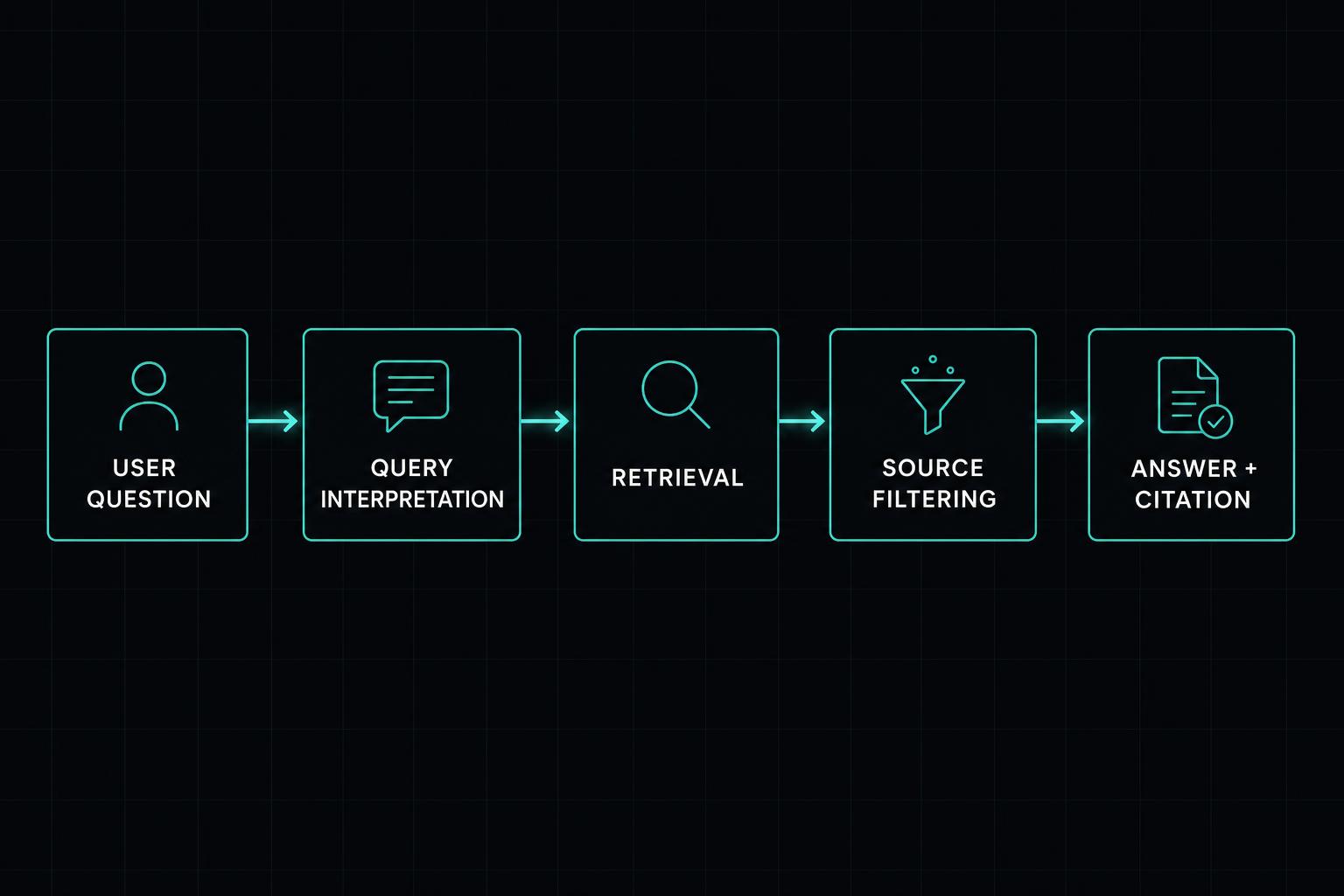
ChatGPT rarely searches the user's exact phrasing. It rewrites the question into one or more targeted queries, then aggregates results across them 2. So a page optimised only for conversational long-tail phrases often misses the rewritten query entirely.

What AI looks for: Pages that signal intent clearly in titles and H2s ('guide', 'comparison', 'examples') and cover a cluster of related sub-questions in one place.
What to ship: Build a small cluster (3–5 pages) around each core intent. Cover the comparison, the how-to and the definition separately, then link them as a hub.
Audit signal: Across 200+ audits, sites with at least one intent cluster were cited ~3x more often than sites publishing only standalone posts.
Common mistake: Writing one long 'ultimate guide' and hoping it ranks for every variant. AI models cite pages with focused intent, not generalists.

02 Authority

Authority signals are what the model uses to decide whether a page is safe to quote 3. They mirror familiar E-E-A-T principles 6, with a few AI-specific twists.

  • Author credentials and visible bylines on every post [6].
  • Outbound citations to primary research, standards bodies and official documentation 4.
  • A methodology or evidence block that shows how the page reached its conclusions.
  • Preference for government, institutional and primary sources on YMYL topics 6.
Audit signal 72% of audited sites had no visible byline on their key conversion pages. Adding an author block with credentials was the single fastest authority win in most engagements.

Citing primary sources also makes the article easier for readers to verify, which supports trust over time. This is the practical core of Answer Engine Optimisation.

Common mistake Stacking promotional language ('industry-leading', 'best-in-class') instead of named authors and dated sources. AI strips marketing prose; it keeps attributable claims.

03 Structure

Structure is what makes a page legible to a model that is skimming for a single citable chunk 4. Clean hierarchy, schema and a scannable layout do most of the work.

  • Article and FAQPage schema on every post; BreadcrumbList site-wide [5].
  • One H1, semantic H2/H3 hierarchy that mirrors the table of contents.
  • Short paragraphs, lists and tables for comparative content.
  • A visible 'last updated' date in the byline area, not buried in the footer 5.
Audit signal 61% of sites we audited shipped missing or invalid Article schema. Most validated cleanly after a single config pass — and citations followed within weeks.
Common mistake Relying on visual hierarchy (font sizes, bold text) without semantic tags. The model reads the DOM, not the design.

04 Recency

ChatGPT weights freshness heavily on trending or fast-changing topics. For news-style queries it often restricts results to sources published in the last 7 days 2; for evolving topics, the last 90.

Based on observed audit patterns, freshness appears more important for fast-changing topics than for evergreen ones. Older authoritative sources can still perform well when they remain accurate, well-structured and widely referenced.

What to ship A quarterly refresh cycle on evergreen pages. Update one or two paragraphs, bump the visible date, log the change in a public change log.
Audit signal 44% of audited sites had no content refresh in 12+ months. Brands that introduced a quarterly refresh cycle saw AI citation frequency rise within 60–90 days.
Common mistake Silent edits with no visible date change. If the model cannot see the page is current, it treats it as stale.
Implementation checklist

Use this list to audit and improve your AI visibility after reading this guide.

  • Add a bylined author with credentials and a visible role on every post.
  • Publish an Evidence & Methodology block that links to primary sources.
  • Implement Article, FAQPage and BreadcrumbList schema; validate quarterly.
  • Show a 'last updated' date in the byline; refresh evergreen pages quarterly.
  • Cluster 3–5 related pages around each core intent so AI sees recurring entity coverage.
  • Earn inclusion in third-party roundups and comparisons within your category.
  • Cite primary sources inline — it helps readers verify and supports trust over time.
  • Monitor brand mentions across ChatGPT, Perplexity, Google AI Overviews and Gemini monthly.
Sources and references

Primary sources, official documentation, research and SkyScale audit data cited in this article. in this article.

  • Introducing ChatGPT search — OpenAI · October 31, 2024
  • How ChatGPT search works — OpenAI Help Center
  • GPT-4 Technical Report — OpenAI / arXiv · March 15, 2023
  • Generative Engine Optimization: Optimizing Website Visibility in Generative Engines — Princeton University / arXiv · November 16, 2023
  • Article structured data — Google Search Central
  • Creating helpful, reliable, people-first content — Google Search Central
Frequently Asked
No items found.
Authorship and review

Man in white shirt and patterned vest sitting in a black leather chair at a table, resting chin on fist.
Written by

Eden John

· Founder, SkyScale

Eden leads SkyScale's Generative Engine Optimisation practice, focused on getting brands cited inside ChatGPT, Perplexity, Google AI Overviews and Gemini.

Relevant experience: Shipped 100+ AI visibility audits across B2B SaaS, professional services and ecommerce between Q4 2024 and Q1 2026, tracking citation patterns across the four major answer engines.

Credentials: Master of Business Administration (MBA) · Founder, SkyScale · 100+ AI visibility audits · GEO, AEO and AI SEO specialist

Smiling young man with curly dark hair in a maroon T-shirt crosses his arms indoors.
Reviewed by

Lachlan McDonald

· AI Search & Data Engineering Reviewer

Lachlan reviews SkyScale's AI search and data engineering content, focused on technical accuracy, methodology, retrieval logic, data quality and source-evaluation claims.

Relevant experience: 6 years of experience across AI search and data engineering, reviewing technical systems and source-selection claims for accuracy, reliability and methodological soundness.

Credentials: Master of Data Science · Bachelor of Software Engineering (Honours) · AI search and data engineering specialist

Last reviewed March 27, 2026
This is the block containing the Collection list that will be used to generate the "Previous" and "Next" content. You can hide this block if you want.

AI Visibility
Report

3 business days. No credit card required, reviewed by a human.

Real Client Results

What you can expect to gain

+1,975%

more clicks from search

Benarrivati

£2,262

revenue from ChatGPT

Avenue Cookery

Google CTR lift

Vision One

+462%

more search impressions

SkyScale

See how we did it